Feb 19 2015

A post to let you know I’m going to write a post.

Rosemary

But I can’t at the moment — I’m still catching up from the Boskone weekend, and three days of Day Job.

Just to let you know… I’ll have stuff to say about Boskone.

Real Soon Now.


Feb 9 2015

Melanie Tem

Rosemary

tem man on the ceiling


I don’t recall what made me pick up The Man on the Ceiling, by Melanie Tem and Steve Rasnic Tem.

I really do wish I could remember.  I had not read any other book by either of them, I think.  And on paper, The Man on the Ceiling sounds like the sort of book that would not have attracted me.  Not so much a novel as a collection of possibly-fictional events and vivid symbol-laden scenes, interwoven with meditations on family, and parenthood, and life and death and love.

Possibly someone whose opinion I respect mentioned it in a blog post, or possibly Amazon’s algorithm saw something in my purchase patterns and suggested it.

Regardless: I do remember clearly that once I had experimentally read a passage or two (probably via the Amazon Look Inside feature), I immediately knew it was a book I had to have.   Whatever sentences I read, they struck a chord.  I bought it.

I think I read the book three times, straight through.  Got to the end, went right back to the beginning.  And did it again.

There was a period when I bought copies and gave them to people — to whoever I thought might respond to it.  And some did — and some did not, and looked at me with a bit of perplexity.

It was (and remains) very hard for me explain exactly why it grabbed me.   But it’s a book that is both frightening and reassuring; and without fail it moves me to tears each time I read it.

Melanie Tem passed away today.   I wish we could stop losing people.

Here’s the announcement in LOCUS.

“If you love someone, they leave you.  But if you don’t love someone, they leave you, too.  So your choice isn’t between loving and losing but only between loving and not loving.”

The Man on the Ceiling, Melanie Tem and Steve Rasnic Tem


Feb 1 2015

Boskone

Rosemary

This year Boskone is February 13-15, and I’ll be there.

For those of you who don’t know, Boskone is the longest-running Science Fiction convention. I try to do it every year (but was not able last year, it being in the midst of my heaviest sessions of chemo).

But here’s a thing I just noticed: On Friday from 2PM to 6PM, all the events are FREE to the public. So, if you’ve never been to a science fiction convention,  and want a free taste, here’s your chance. Head over to the program schedule and take a look: there are some really interesting items taking place in the “free” period.  The convention takes place in Boston, at the Westin Waterfront .

As for my schedule, it’s this:

Reading: Rosemary Kirstein
Saturday 10:30 – 10:55, Independence (Westin)

Mining Fiction and Music for Creative Inspiration
Saturday 14:00 – 14:50, Marina 4 (Westin)

While fiction inspires music, music also inspires fiction. How do these two forms of expression interact? Panelists discuss examples of music or fiction that were inspired by the other genre. Who are the great literary musicians? Discussion may also include some live demonstrations as examples.  Panelists: F. Brett Cox (Moderator), Maya Bohnhoff , Rosemary Kirstein , Beth Runnerwolf, Mary Ellen Wessels

Writers on Writing: Worldbuilding from the Ground Up
Sunday 12:00 – 12:50, Harbor III (Westin)

Some spectacular stories take place in worlds very different from our own: from life on (or in) a gas giant to a civilization that lives on a world-tree as big as the Himalayas. But there are perils associated with venturing far beyond human experience. An inconsistent or poorly described worldscape can furnish a confusing story, or challenge a reader’s ability to suspend disbelief. Hear from writers who have created fully realized worlds that their readers can almost see, touch, and smell.  Panelists: E. C. Ambrose (Moderator), Myke Cole, Peadar Ó Guilín, Lauren Roy, Rosemary Kirstein

Autographing: Steven Brust, Rosemary Kirstein, Darrell Schweitzer, Jill Shultz
Sunday 14:00 – 14:50, Galleria-Autographing (Westin)
This is only the second convention I’ve done since going through my various treatments and surgery.   I made it to Readercon last year, but I was pushing it, a bit.   I had only one panel, and that was about all I could handle, really; and I don’t feel I was at my best.

I’m still not quite at my best… I don’t feel as sharp as I’d like, nor as mentally nimble (very useful during panel discussions, where one sometimes has to be certain to get heard).   Still, I must come out of hiding at some point!

And yes, I am doing a reading.  I have no idea what I’ll read, yet.  But something will be read.  By me.

I note that I seem to have no Kaffeklatsch, and I wonder if I forgot to ask for one?  Too late now.

Of particular interest:  Jo Walton is conducting an interview with Guest of Honor Steven Brust.  Both Jo Walton and Steve Brust have readings, as do Jane Yolen, James Patrick Kelly, and Charles Stross (whose reading takes place during the “free” part of the convention).   Also,  some of the panels sound fascinating — they always do, and I can never manage to get to as many as I’d like.   I hope to catch some poetry and music, too.  (Alas, I won’t be performing, myself — I’m not fit for that, yet.  Chemo and peripheral neuropathy  have conspired to make it hard for me to play guitar for very long, meaning that not only can I not play for long, I’m also seriously out of practice.  And my singing voice is sort of… shredded.  And my breath control is non-existent! As a performer, I’m a mess.  But!  Next year!  I’ll get it all back!)

Well.  Must get back to work now (my work, not the day job), which at the moment consists of prepping for my panels and figuring out what of this  great mess of a book can possibly be extracted to read in public in a coherent fashion — and if possible can it be something that I have not read in public before?

Plus: getting ready for the next great snowstorm, which apparently should hit, oh, any minute now.


Jan 26 2015

Everybody in the east is just waitin’ for that blizzard

Rosemary

Hasn’t hit too badly yet, here in Southern Connecticut. The worst is supposed to be from midnight tonight through tomorrow.

I expect to not go in to the day job. Which is nice.

But I also expect not to be able to get to my own office. For which, insert frowny face.

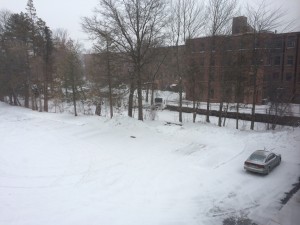
My car, in the lot.  Not much snow on it (yet), as you can see.

My car, in the lot. Not much snow on it (yet), as you can see.

I am here today, for a bit, but will leave before the driving gets bad.


Jan 24 2015

Facebook matters

Rosemary

Some of you have sent me “friend” invitations on Facebook.   I have to let you know that I don’t generally accept invitations from strangers.

I actually have two Facebook accounts….

One is my personal account, mainly for family and friends (and people my actual friends want me to know), and  co-workers, and colleagues.  Plus, people in the biz with whom I am connected, or who I need to stay aware of (some people belong to all those categories).

The other is my professional Facebook “Page”, which is open to everyone. You don’t need to be invited to see the posts, and if you click on “like”, the new posts will show up on your news feed exactly as if you had friended me.

And really, when you come right down to it  — you’re not missing anything by going with the Page.   Because I almost never post directly on Facebook.   Generally, I write my blog posts right here, and then go over to Facebook and just say, “Hey, I have a new blog post!” and provide a link.  That’s basically it.  I do that in my personal account ,  and on my professional page.  And I do the same with Twitter, actually.

What I’ve got to say, I tend to say here.

I mainly use Facebook to stay on top of what everyone else I know is doing.   And I’ll comment on their posts.    But are you really interested in seeing me say “Cute!” when my pal from grade-school posts photos of her new grand-daughter?  These are not people you know!

Really, all the interesting stuff that happens in my life is said here.  When I talk about it at all, that is.  I’m just not much of a posting person.

Only exception: Twitter. While I almost never tweet on Twitter (except to provide a link to my latest blog post), once in a blue moon I’ll make some remark or other.  Usually out of frustration or boredom, when I’m trapped in an airport or something.  If you never want to miss these, I am @rkirstein.

But please don’t be offended if I reject your Facebook invitation.

Thanks.


Jan 19 2015

Into the Village for an evening in Night Vale

Rosemary

Yes, I was in the audience for their live show on Friday night.

I couldn’t make a whole day of hanging around in New York, unfortunately — I’ll have to save that for another time.  So I hopped the train that would get me there in time for dinner before the show.

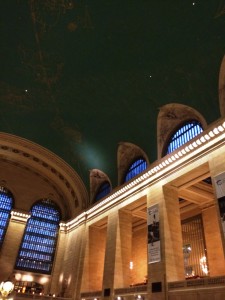
I love the ceiling at Grand Central

I love the ceiling at Grand Central

The show was at the Skirball Performing Arts Center, down in the heart of Greenwich Village (where I used to hang in my folkie days). Whenever I visit the Village, I experience a weird sort of double vision. I see what’s there, and my interest and response is to what is really there — but some of the emotional resonance remains of what was there when I was young, when the Village was new to me.  It’s sort of like looking at a person, and also at their shadow, but the shadow does not match the person. Or like standing between two mirrors, and seeing that infinite replication — but somewhere deep in the repeated reflections, the images no longer match the original.

Not in a spooky way (which it certainly would be if that happened in real life).

In fact, there are a couple of places in the Village that I can recall from the very first time I was there, when I was eighteen, and the sidekick of a girl who knew a comics writer, and we went to a party in an apartment off Washington Square.  If I stand in one of those places, I get a triple resonance (what it meant to me at eighteen; what it meant to me in my twenties and thirties; what it means as I look at it now)  that really is quite interesting, and quite odd.


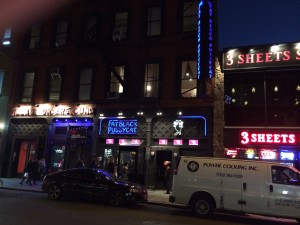
This used to be Gerde's Folk City.

This used to be Gerde’s Folk City.  Now the Fat Black Pussy Cat, which is itself a name of long fame, but not at this location.


I wanted to wander the streets, take in the sights, but — damn! It was  eighteen degrees (Fahrenheit, that is; -7.77 for you Celsius users).  Way too cold for perambulating.

The show itself — Ah.  Love Night Vale, love the live shows, love the podcasts, love it all.

I won’t say too much about the content of the show — they’re going to be releasing a recording of it.    But I will say that the script was one called “The Librarian”,  versions of which they’ve performed live in the States several times.

An updated version was also used  in their massive tour of Europe last year.   So, even though live shows of Welcome to Night Vale are staged as radio plays, with people standing and talking into microphones while holding their scripts in their hands, mostly they didn’t need to consult the scripts very often.  They’ve done this show a lot.

The show had everything you could want from an episode of Welcome to Night Vale: the eerie; the amusing; the weird-to-you-but-perfectly-normal to us; the romance (with many a squee! from the fangirls); the charm; and the sudden utterance of a deep truth about reality that you did not notice before but which now cannot be denied…

All that stuff.

But it was also the scariest episode I have ever heard.   Edge-of-the-seat, heart-pounding scary.

And at one point, in the middle of the scariest part, I found myself asking: How is this even possible?

I looked around.

One big room.  850 people.

One man in front.  All alone.

Saying… words.

850 people riveted.  Fascinated — and scared.

How does that work?

Of course, we see this every day, don’t we?   We take in words, we put out words.  And the words scare us, comfort us, enlighten us, take us away from some things, put us directly into the true and beating heart of other things.   We escape, we approach.

We can subtract everything else, put ourselves in dark rooms with nothing but a voice (or eyes moving across a page) — and we blossom universes inside.

I feel like “imagination” is not a strong enough word for this.   Because “imagination” seems to imply making stuff up, an apparently frivolous act. But in order to understand anything, you have to also imagine it.   Replicate it, reflect it, model it internally, matching it to reality, but containing it within yourself.

So… this is an act of creation undertaken by 850 people simultaneously, using the cues, clues, raw material and enacted example provided by the man in front.

Well, that’s the phenomenon; then there’s the skill involved.

Crappy, ham-fisted writing would have made the shared creation impossible.  But Jeffrey Cranor and Joseph Fink are very, very good writers indeed.  Every word uttered on that stage, every concept, every emotion,  was put there by them: all the movement of story, and the orchestration of emotion, set up by them.

And a lousy actor would have destroyed it all.  But Cecil Baldwin was almost impossibly brilliant in his role.  Maybe there are other people who could have delivered those words, and done it well; but it would have been a different story, it wouldn’t have been this story.  I can’t say enough good things about him.  The man is a treasure.

And there was the skill of the audience.  There exist many, many people who cannot do this thing –  this taking in of words and making them real inside.  People of that type, placed in that audience, would experience nothing but, perhaps, perplexity.  But I believe that the audience that night was composed of people with great talent in turning the seen and heard into the experience of Art.

Well.   That’s rather a lot of philosophizing about a live episode of a very popular podcast…

But, see, that’s another thing I love about Welcome to Night Vale; it makes me think about this stuff.   I get not only the pleasure of the episode, but the meta-pleasure of watching something done well.

After the show, I wanted to hang out at a coffee shop and sip coffee contemplatively while writing in my journal.  Unfortunately it was so cold that every human being was driven indoors, and every restaurant and coffee shop was packed with people elbow-to-elbow with no room for even one more person with a pen and some paper.   So I took the subway uptown and caught the train home.


Jan 10 2015

Same here only more so

Rosemary

Back in October, Hugh Howey (you know, of Wool fame?) wrote a blog post that addressed a matter of particular interest to me:

“… It’s 1 time out of 100 that I write in public (usually by necessity, not by choice).

It’s 1 time out of 100 that I write a scene that makes me cry (again, no stopping it).

It’s 100 out of 100 times that these two overlap. Why the hell?”  [see the whole post and the many replies…]


I was one among the many who replied — I just had to.  I said:

Crying can be an issue, but in theory I can avoid public writing when working a sad scene…

But I’ve got this whole other problem: my face reflects what I’m writing, ALL the time.

If my characters are angry, I look angry. If they’re puzzling something out, I’m wearing a quizzical squint. Startling revelations? Transcendent epiphanies? Betrayal by presumed sweetie-pie? Right there on my face.

And, oh, yes: I write Science Fiction and Fantasy, so monsters are possible. And bloody death. And even exaltation.

More than one total stranger in a cafe has asked me if I’m all right. Worse yet, a friend once treated me to a re-enactment of my sequence of expressions, which he thought was completely hilarious. He laughed and laughed. I just sat there stunned and appalled.

Since that time, when I write in public, I rarely write actual prose. Generally, it’s analyses, outlines, journal entries — working through ideas in some way. Much safer.

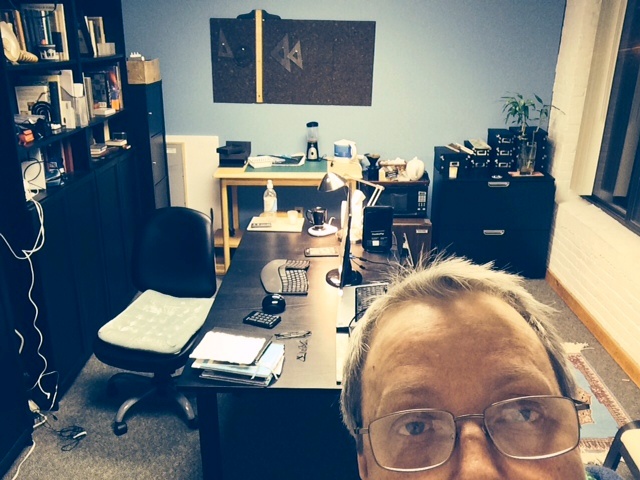
It’s one of the reasons I got myself an off-site office.

Other reason: elbow room.  The table I used as a desk in my bedroom had 1/3 the usable space this one does. And put my nose less than two feet away from a wall.

Other reason: elbow room. The table I used as a desk in my bedroom had 1/3 as much usable space this one does. And put my nose less than two feet away from a wall.


Some people are great at ignoring their surroundings, so what they see around them doesn’t distract, beckon, admonish, oppress, or prompt response.  Not me.

In fact, I cleverly trained myself to really notice stuff, starting back when I was a kid — intentionally, in order to improve my writing.

I feel it’s served me well.   But it’s hard to turn off sometimes.

Thus: office!  And thank you, ebook purchasers, for making it possible.


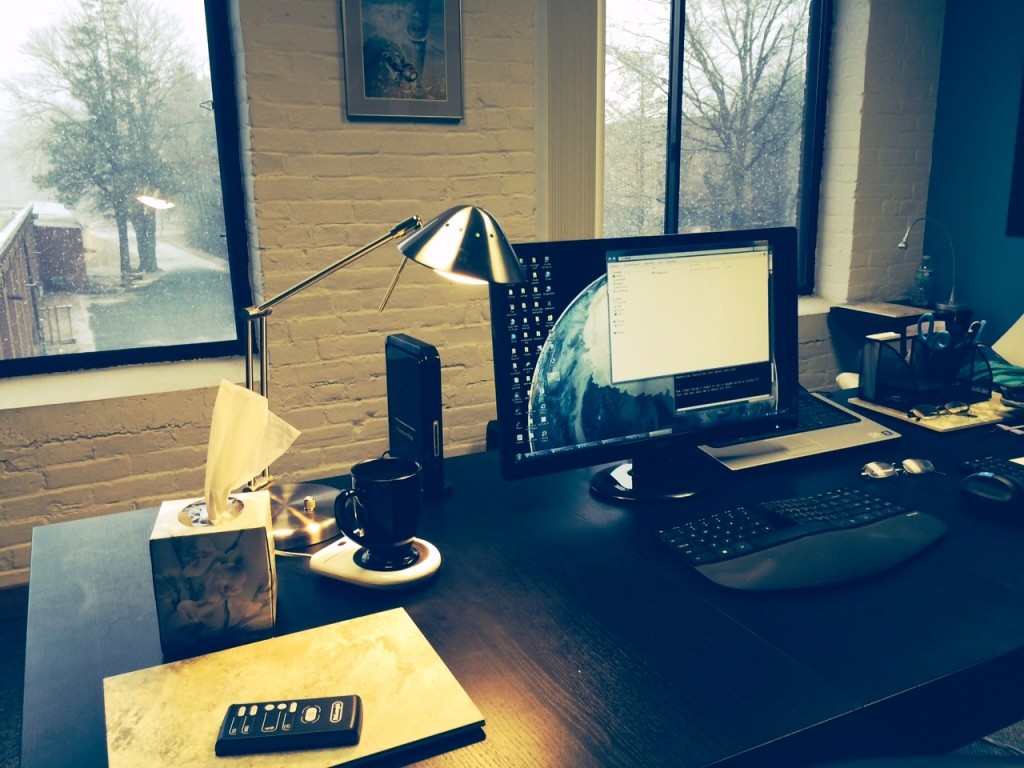
Other other reason: windows. No, they do not distract, they encourage standing with a cup of coffee in hand, sipping, while gazing into the far distances contemplatively.

Other other reason: windows. No, they do not distract, they encourage standing with a cup of coffee in hand, sipping, while gazing into the far distances contemplatively.


Jan 2 2015

The people who joined us.

Rosemary

Thursday morning, the alarm goes off.

And as often happens when I am reluctant to rise and face the new day, I grabbed my iPhone and had it stream the local NPR talk station for me while I worked up the willpower to forgo sweet snoozing in favor of actual verticality.

I heard: “Thank you for joining us here on the first day of 2015!”

Oh, right, said I to myself. New Year. Yeah, worth getting up for. I started stirring my bones…

“For today’s show,” the announcer went on, “we’re going to look back and take a moment to appreciate some the people who left us in 2014.”

Wait, what? I thought.

“There was Shirley Temple Black, child actress and later ambassador to the UN; and folksinger and activist Pete Seeger. We were shocked by the passing of Robin Williams –”

But, but, I thought, but that’s sad.

“– We’ll celebrate the lives of rocker Joe Cocker, and authors PD James and Gabriel Garcia Marquez; inspirational poet Maya Angelou; film icon Lauren Bacall; comedians Sid Caesar and Joan Rivers — all people who touched our lives, made us think, made us laugh, changed our world, and moved us. Call in with your own impressions —

Click

Radio off, thank you.

And I burrowed back down into the nice warm bedding.

That, I told myself, is absolutely not what I need. I just spent all of 2014 being treated for cancer, for cryin’ out loud! The last thing I want to do on the very first day of the brand new year is to start the whole thing off by thinking about DEATH DEATH DEATH.

In fact, I thought dozily, what really I wanted was something exactly the opposite of that.

Like:

It’s January 1, 2015, and welcome to the new year! Today on our show, we’re going to be looking back and taking a moment to appreciate some of the people who joined us in 2014.

There was Boyd Craighie, born January 1st, one year ago today in Leeds, England. Boyd will later find fame as the lead singer and songwriter for Sky VoiceBox, whose music in the 2030’s will become the soundtrack for an entire generation worldwide, inspiring billions.

And on January 15, 2014, future Nobel Peace Prize winner Lewis Hart Griffith was born in Vancouver, Canada. Griffith, later Canada’s ambassador to South Korea, will be awarded the Peace Prize 2042, in recognition of his contribution as calm voice and go-between, during the volatile secret talks that eventually lead to the unification of North and South Korea.

On March 22, Jane Luganish joined us, born in Fort Myers Florida. Luganish will win two consecutive Academy Awards in 2036 and 2037, for best NPC in an MMORPG (Sub-Zoners, and Sub-Zoners II). Later, she leaves gaming to enter traditional media entertainment, winning a third Oscar in 2043 for her heartbreaking performance as the lead in Distant Sands, the biopic of Anna Wray, first human on Mars.

And, born on June 28th, 2014: Grace Adoyo in Narobi, Kenya. In 2051, Dr. Adoyo and her team at Aga Khan University will develop the first vaccine effective against the Ebola virus, leading to the complete eradication of the disease worldwide by 2063.

On July 5th, 2014, Michael Thammed Hailey was born in Des Moines, Iowa. Hailey, after retiring from teaching science at Roosevelt High School, will enter local politics, and rise quickly, becoming mayor of Des Moines, then Lieutenant Governor of Iowa. In 2076 he becomes the fifth African-American president, after defeating incumbent Martin Leigh Salters, the fourth African-American president.

And on Sepember 12, Xi Lanying, future author of children’s books and YA novels, was born in Hangzhou, China. Xi’s works will be translated into every major language and read worldwide, delighting children and inspiring teen readers everywhere. A television series, “Ping,” adapted from her second novel, will be the longest-running television show in history. After officially retiring in 2084, she will come out of retirement in 2088 with the stunning Pulitzer-Prize-winning Chain and Song, a biography of her mother’s life in, and courageous escape from, the world of human trafficking.

And at 11:59:55, on December 31st, 2014, Stephen Alton Keogh was born in Christchurch, New Zealand.  Keogh eventually lives to be the oldest human being in history, and in an interview in New York City’s Times Square, minutes before midnight on December 31st, 3014, a news swarmbot will ask him what it feels like to be one thousand years old.

Keogh’s reply: “I can’t wait to see what happens next.”


Oh, look.  New people.  Some of them are very nice!

Oh, look. New people. Some of them are very nice!


Dec 29 2014

Radiation therapy and me

Rosemary

They told me three things, over and over:

1. You won’t feel anything at all.

2. The treatment is over very quickly — the actual radiation part just takes a few minutes.

3. The machine will never touch you.

They said that so often (the radiation oncologist, the radiation therapy nurse, the RT techs, the books and websites I consulted), that I realized that these were the three things that most people found most scary. Will it hurt? How soon can I get out of here? What is that thing, and what is it going to do to me?

Those reassurances got said a lot because they usually need to be said a lot.

To the average person off the street, radiation mostly means atomic bombs, and possibly nuclear power stations melting down and poisoning everything, and people dying in horrible, agonizing ways.

The healthcare providers had to work against those preconceptions. They explained, reassured, and tried to make everything as non-threatening as possible.

And I figured, even as geeky as I am, I probably had a lot of those same preconceptions and negative associations stuck way down deep in my psyche, absorbed from the general culture, where they might leap out at me unexpectedly — and, say, cause me to completely freak out during treatment.

Which I did not want to have happen. I’d be getting radiation therapy five days a week for eight weeks, and it would be great if my lizard-brain wasn’t trying to kick me into flee-in-terror mode every time.

Forewarned is forearmed, so I reviewed all the info I was given, read up on the events that would take place during treatment, did a little deep breathing, and reminded myself that all this was happening because things were going better than expected.

According to my original treatment plan, I was going to have two kinds of chemotherapy, a mastectomy, and then some more, lighter chemo (Herceptin only) — and the timing even would even allow me to get to the World Science Fiction Convention in London in August.

But (as my regular blog readers will recall) the two rounds of heavy-duty chemo worked brilliantly.  My tumor shrank and shrank, and eventually became undetectable by x-ray and ultrasound.  In fact, a biopsy (remember that unplanned biopsy?) actually showed no sign whatsoever of any cancer remaining in the area.

So, no mastectomy after all, gladly. Just a “lumpectomy” (more accurately called a partial mastectomy). A fairly large one, but nothing like a full mastectomy.

But with a lumpectomy, you get radiation. This, to chase down any random cancer cells that might have stayed behind after the surgery, and zap them dead before they do their out-of-control reproduction trick. I knew that there would be side effects to the radiation, and the effects would accumulate (and might become pretty nasty), but the delivery of the radiation doses would not actually hurt, or even be felt at all.

So, I went through all the preliminaries: the CAT scan to identify the exact measurements of the treatment area (so they don’t irradiate more of your body than needs it); the simulation, where they test out the aiming; the tattooing of tiny dots to help with the precise aiming; getting my body position exactly right, and making the custom brace to hold me in that one right position, so that everything is the same each time, no variation — all that.

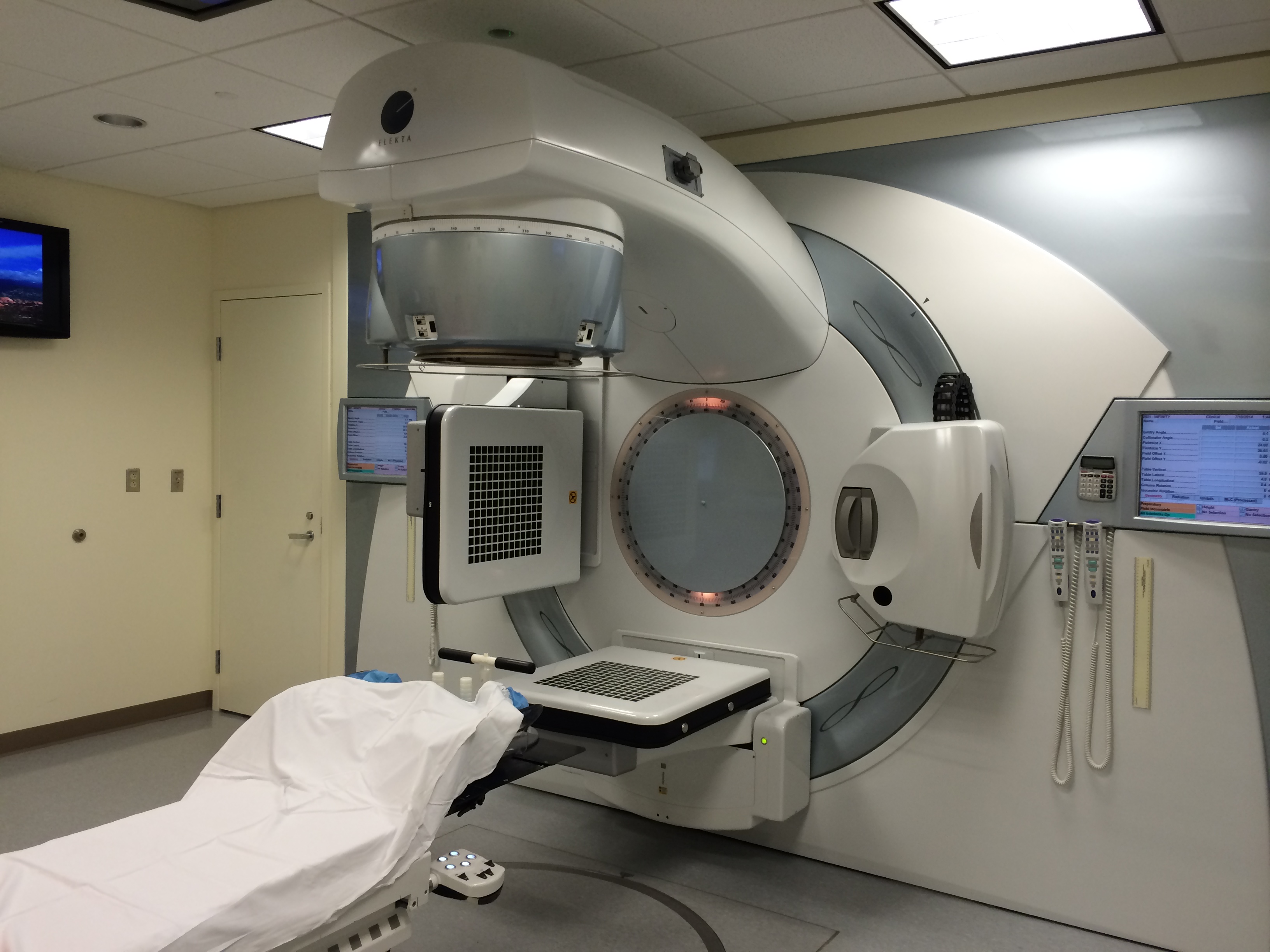
Eventually we got down to the real deal, and I found myself being led down the little corridor with the large sign saying PATIENTS ONLY IN THIS AREA; and the other sign with the light, saying RADIATION IN USE WHEN LIT; when I noticed another, little sign on the wall by the entrance, reading:

LINEAR ACCELERATOR

Wait, what? I said to myself as we passed it by and continued down the hall.

In the treatment room, the radiation techs ran over everything one last time, including reminding me: I wouldn’t feel a thing; the actual radiation part would be over quickly; and the machine itself would never touch me.

Them: So, that’s about it. Now, before we start, do you have any questi —

Me: Yes. Yes, I do.

Them: Oh — Okay, what’s your ques —

Me: Is this really a linear accelerator?

Them: Well… yes. Yes, it is.

Me: THAT IS SO COOL!

Them: (pause) …what?

Me: Seriously? A linear accelerator? So, subatomic particles are going to be sped up to, like, 99 percent of the speed of light? Right here?

Them: … yes…

Me: For me?  To zap my cancer? An actual linear accelerator?

Them: Well, yes —

Me: THAT IS SO COOL!

Them: (big pause) … really?

Me: Yes.

Them: Well… you know what else is cool? This whole thing is computer driven, with all your measurements stored, along with the treatment plan and digital control of the specific gantry movements …  and we work it from this console over here… there’s a digital 3D mockup of your treatment area, and — would you like to see?

Me: YES, PLEASE.

So they brought me over to the console and showed me the mockup of my treatment area: an exact and precise little bit o’ me, color-coded, rotatable in three dimensions on the screen, and it was also so extremely cool.

Me: This is one slick machine.

Them: It’s amazing.

And it was.
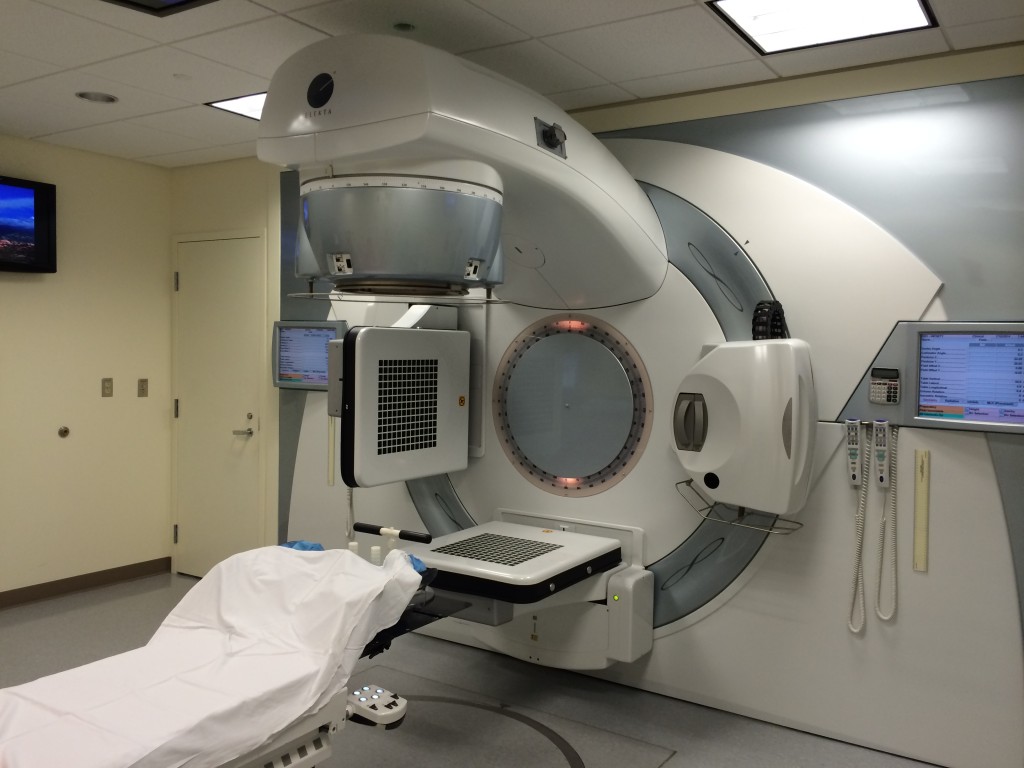
sleek & sexy public face

sleek & sexy public face


Come on — what sci-fi nerd wouldn’t love this? With all the calibration circles, and the sleek cowling, and the way the gantry completely rotates all around the patient, so once you’re in place you don’t have to reposition at all.  Minimal fuss.  It’s not just pretty — it’s such a smart design.

Possibly sometime before this point, it had been mentioned to me that a linear accelerator was used, and I just missed it.  But, I don’t think so.

I had been told what to do during treatment, and the fact that a machine would be used to deliver the radiation.  But somehow I got the idea that they had some, I don’t know, radioactive substance in a container, and they’d point it at me and open a little window of some sort, allowing the radiation to escape and wash across my cells.

But no, nothing of the sort.  The linear accelerator uses radio waves to speed up a stream of electrons to close to the speed of light; and magnets control the stream and focus it; and the beam hits a tungsten plate, and the plate spits out x-rays.  On demand.  A beam of x-rays, which then gets focused and further refined and shaped before reaching the patient.

There’s only radiation when the machine is actually being used. And only the exact amount that you need.  And carefully focused, and precisely aimed — it’s a thing of beauty.
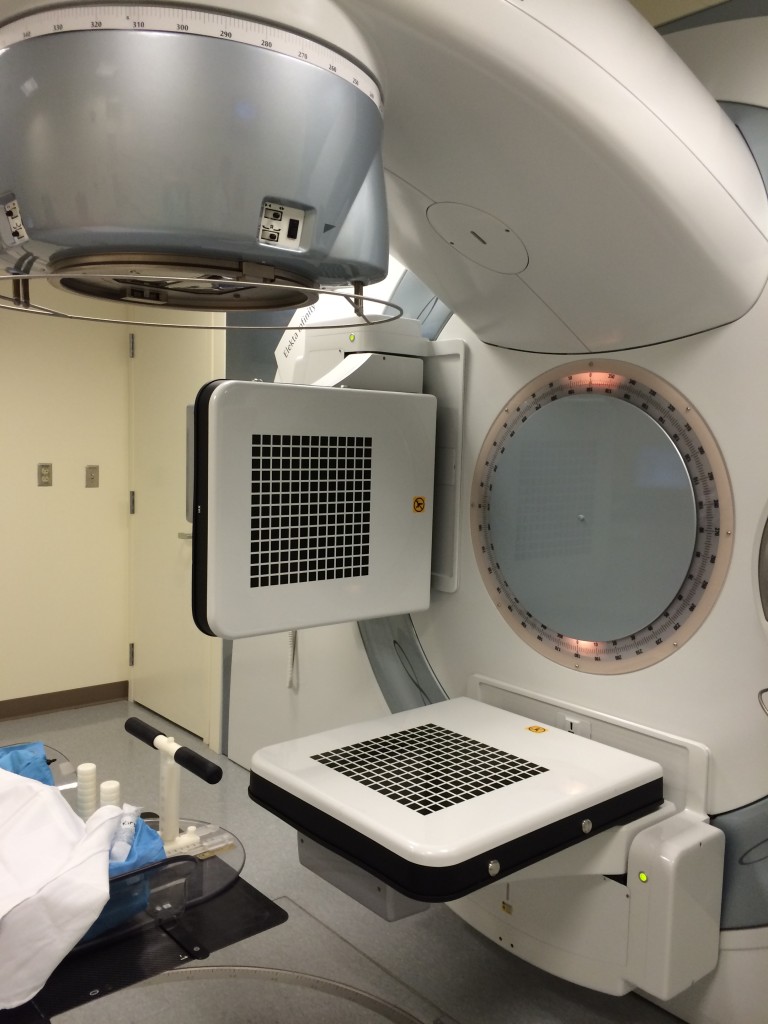
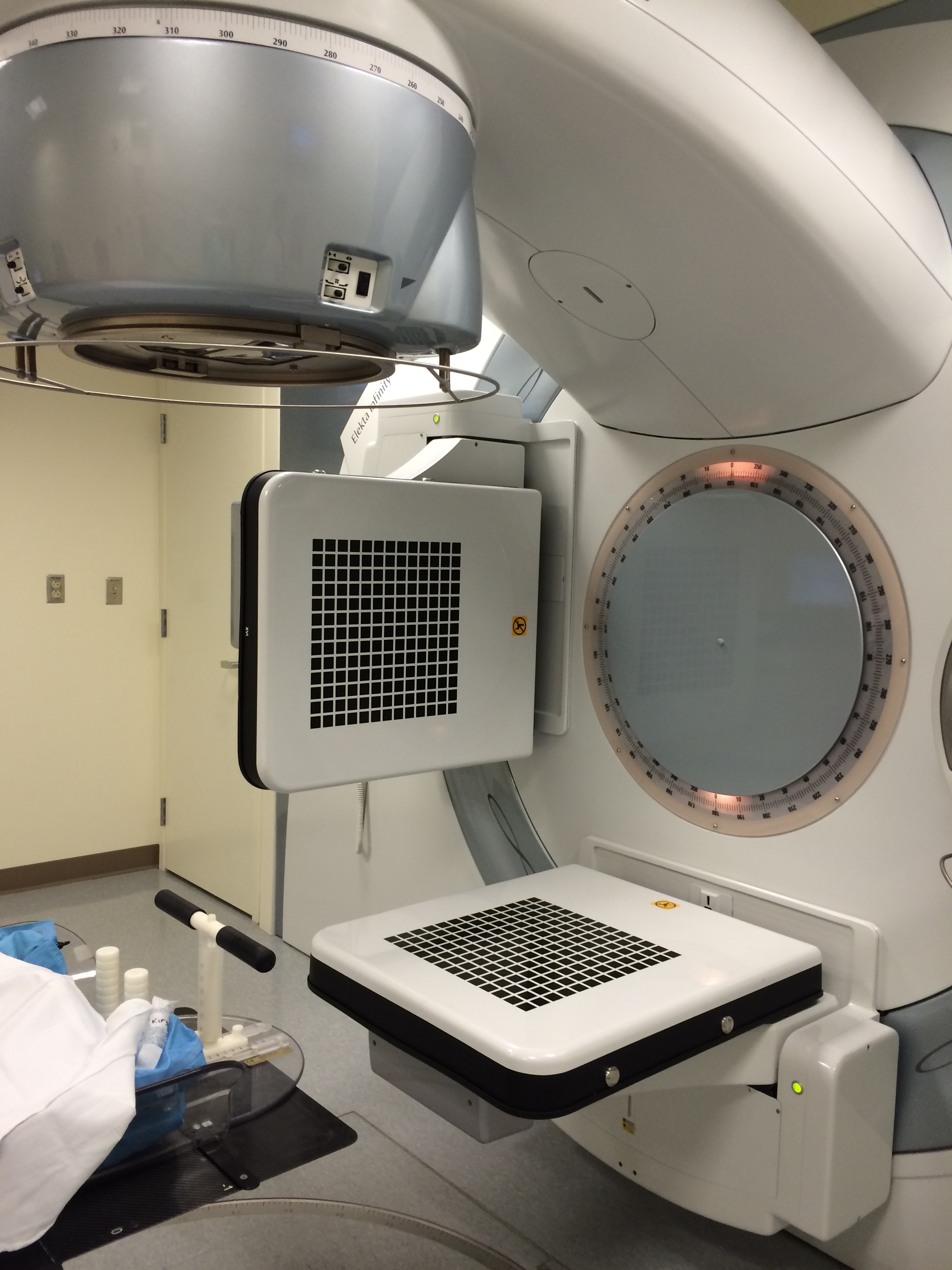
classic lines. Plus: cool calibration indicators

Classic lines. Bonus cool calibration indicators.

Plus: linear particle accelerator?  That’s the same thing that feeds the initial particle stream into the Large Hadron Collider.

Okay, they’re using protons and we’re using electrons… but hey, same damn concept, right? How is this not cool?

I let the techs know that I was a science fiction writer, which helped explain to them my deep delight in this wonderful machine.  They loved it too!  They were proud of their machine, and proud of how it helped people — and they were resigned to the fact that most people were going to be afraid of it.  And they did their best to calm the fears, and reassure their patients.  But these ladies (and they were ladies — all the radiation techs were women), they knew what a fine technological accomplishment this machine was, and they were glad to be the ones using it to help save their patients lives.

And I was (and they told me this) the only patient to ever actually like the Elekta Infinity Linear Accelerator as much as they did.

Them:  Do you want to see behind the scenes?

Me:  Do I? YES.
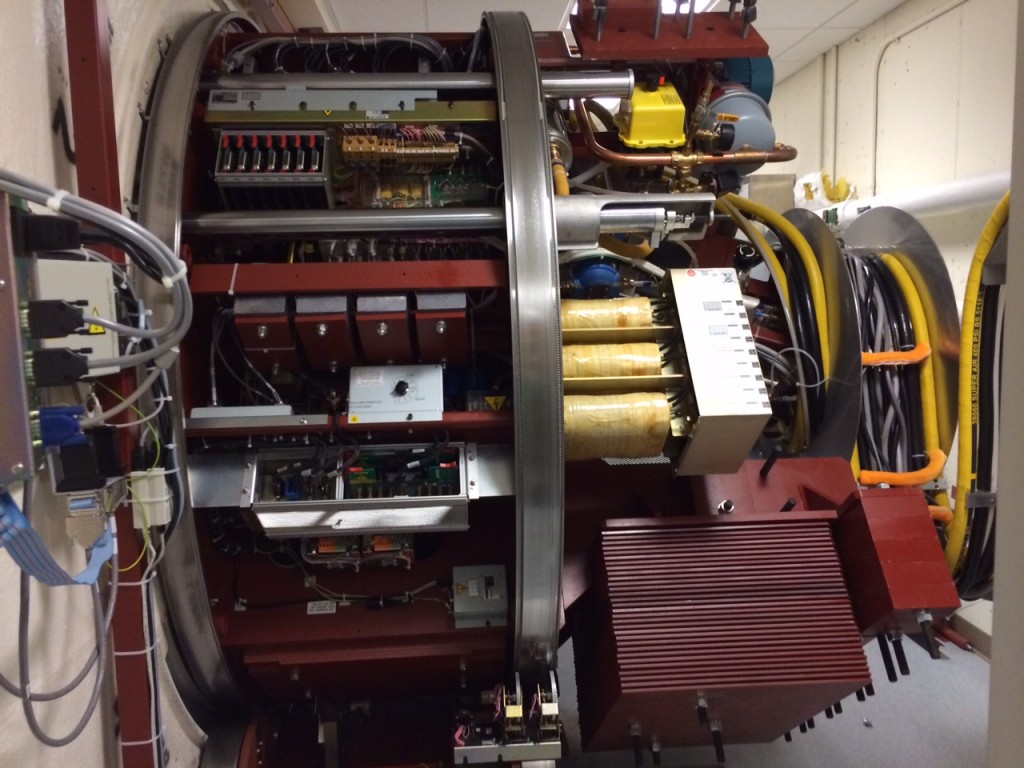
Behind that wall.

All the heavy lifting is done here.


Me: Well. Now it looks like a particle accelerator.

Them: (giving me the side-eye) And how many particle accelerators have you seen?

Me: Um. I took the tour of Fermilab, back when the Tevatron was operating. And of course I’ve seen any number of photographs of the Large Hadron Collider…

Them: (amused) Okay…

Yeah, it doesn’t look exactly like either one of those… but I feel I detect a sort of family resemblance.
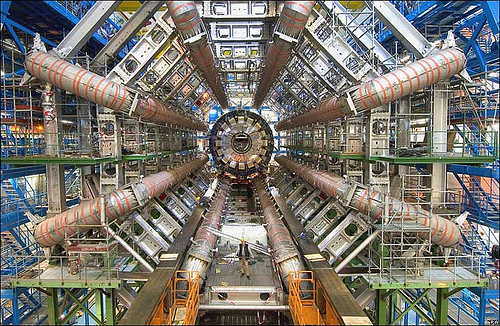
 

Elekta's big brother

Elekta’s big brother


So, what’s the point?

Cool trumps scary.

Eight weeks, five days a week, I’d sit in the waiting room with all the other patients scheduled before and after me.  And when my name was called, I’d stroll on into the treatment room, cracking jokes with the techs, slide into position, let the techs micro-slide me into a more precise position; and the lights would dim, and the women would speak quietly to each other for a while, chanting numbers; and the laser aiming light would locate my position even more precisely… And the techs would step out of the room.  And the gantry would hum and move about. And pause, and click a bit, and pause; doing its job, accelerating electrons up toward the speed of light…

I didn’t feel a thing.

It was over very quickly.

The machine never touched me.

But I had to resist the impulse to give it a little friendly pat on my way out…
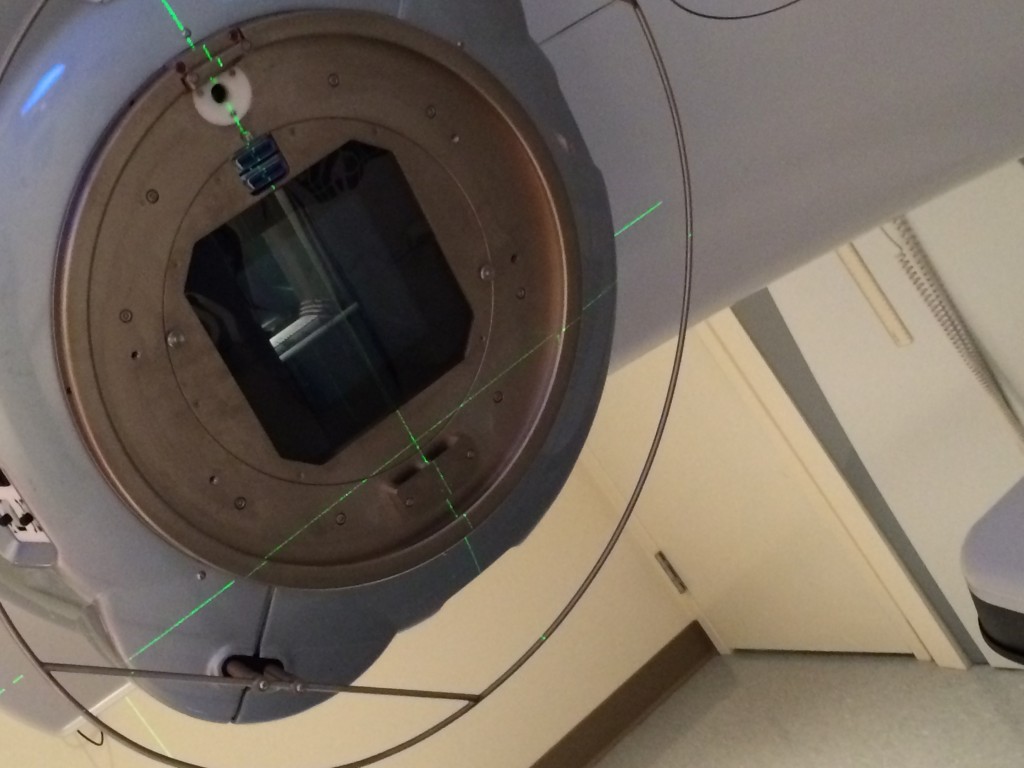
Extra coolness because: lasers.

Extra coolness because: lasers.


(Here’s a video by the company that makes the Elekta LINAC, that explains it all.)


(Added later: I’ve collected  most of the posts about my cancer experience in one list here, if you’re interested and don’t feel like searching through the archives.)
Dec 26 2014

Coming soon: one-year wrap-up

Rosemary

As it’s been just over a year since I was diagnosed with breast cancer, I thought I’d do a year-later wrap-up  — but then I realized that I hadn’t written my post about my experience with radiation therapy.  And I really wanted to get that down on record, so to speak.  So,  I’ll do that first (probably by the end of Saturday), and do the year-later post shortly thereafter.

Of course, you know the short version: I am alive.  And so are you.

That’s a happy holiday in my book.