Aug
28
2013
Vs.
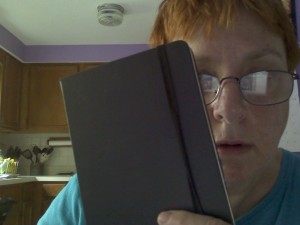
- Moleskine, large hardcover, with grid
Versus:
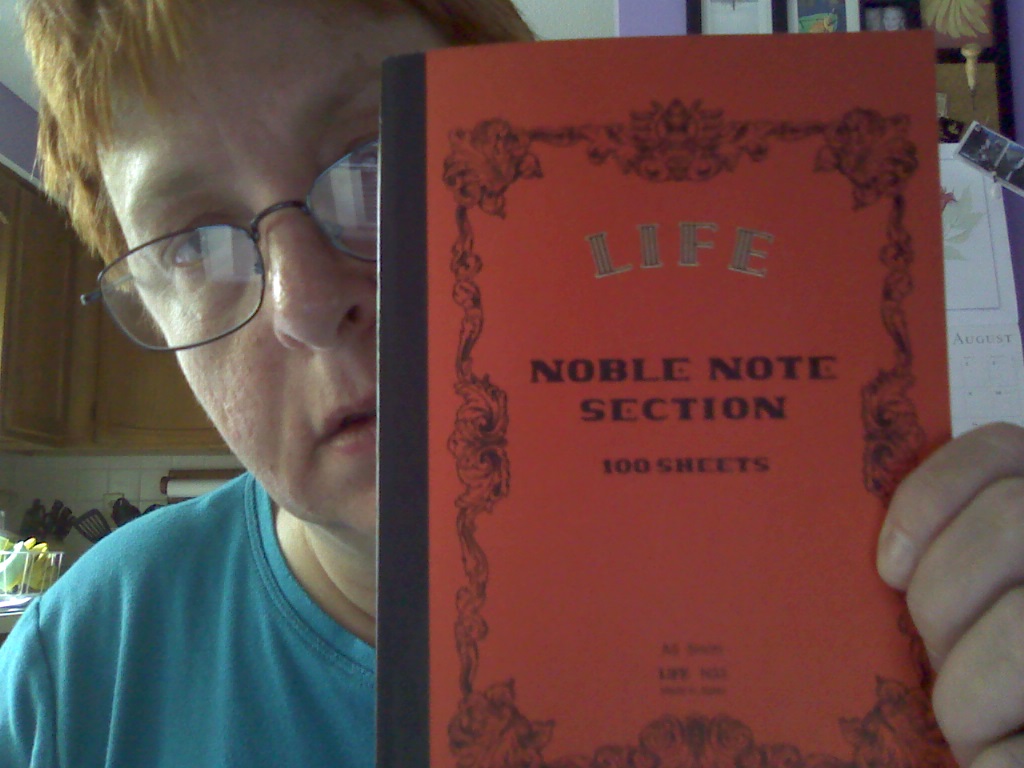
L!fe Noble Note, size A5, with grid
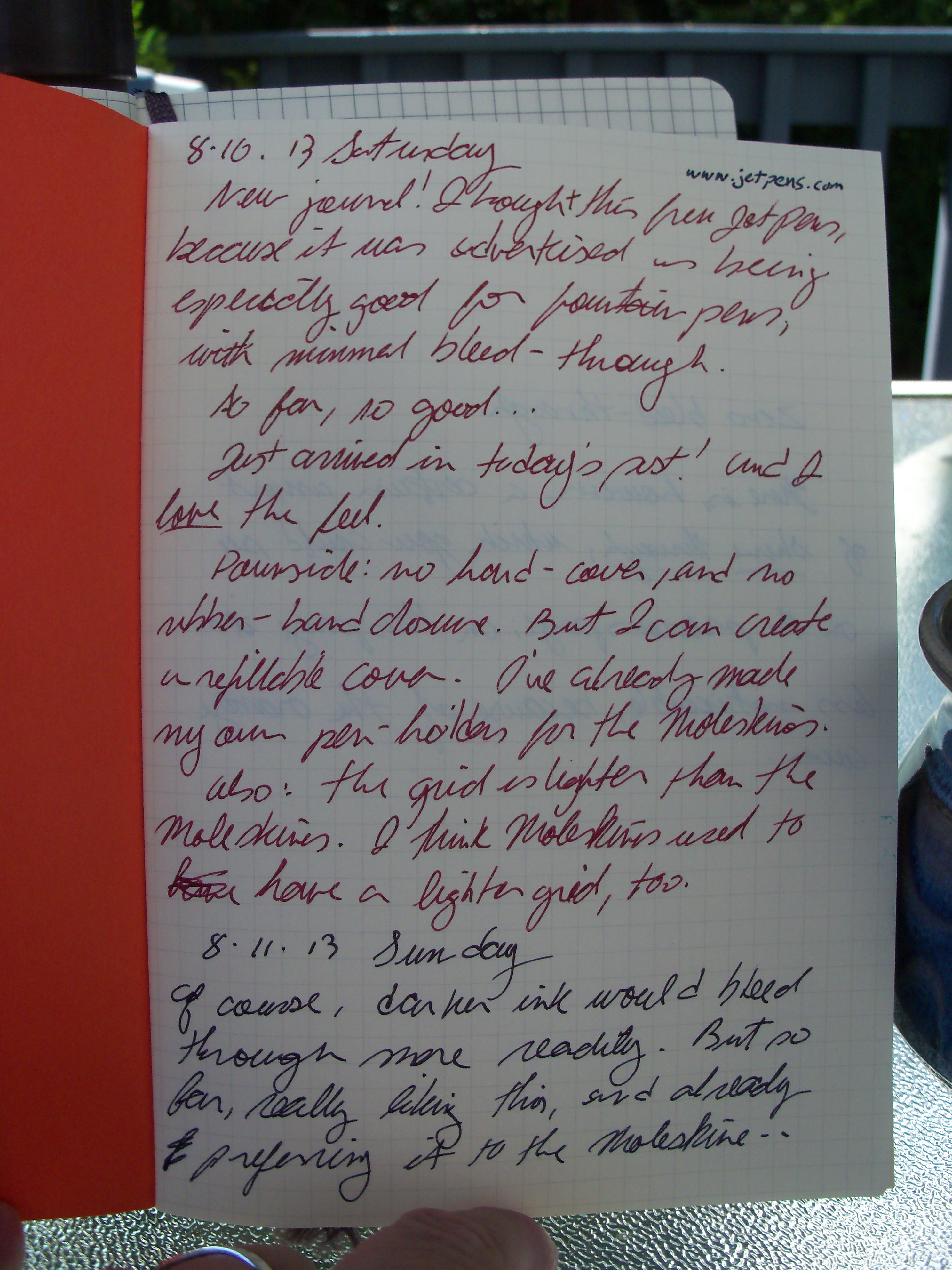
L!fe Noble Note
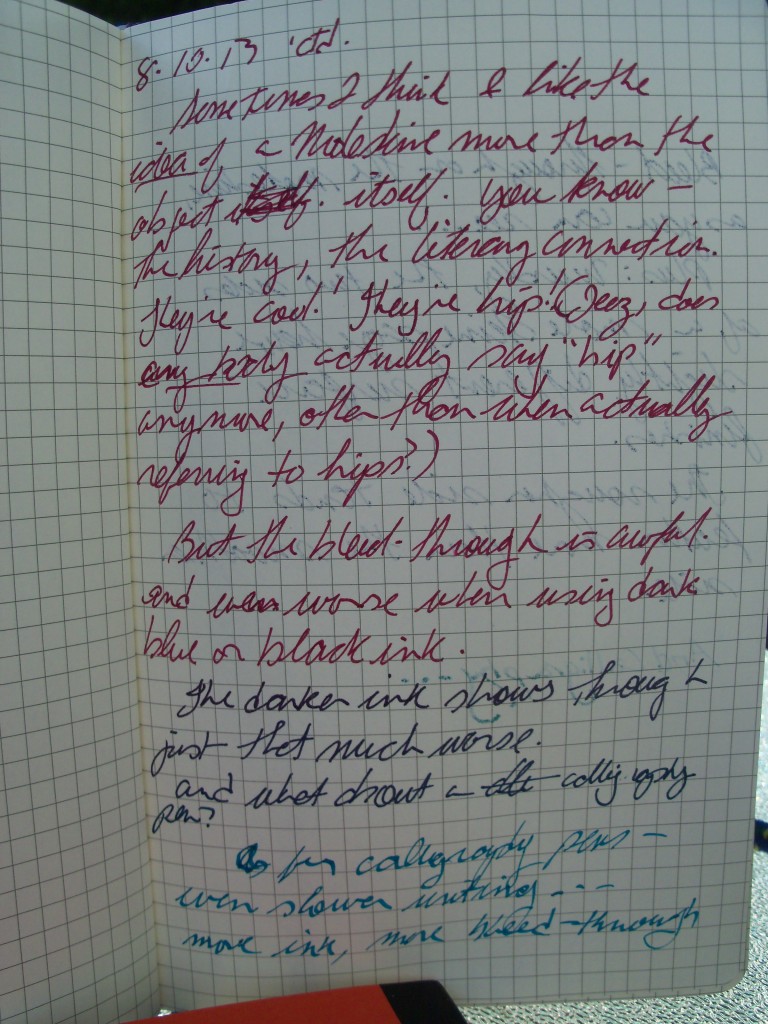
Moleskine
Versus:
L!fe Noble Note, size A5, with grid
L!fe Noble Note
Moleskine
The audiobook version of Ellen & Delia’s collaboration of The Fall of the Kings is going on sale August 27th, but you can get a copy for free!
They’ve come up with a promotional contest that looks like a lot of fun: Swordspoint Cuisine. Deadline is 5PM EST on Friday, August 23rd.
They want recipes.
The Fall of the Kings takes place in Ellen’s “Swordspoint” world, and the city of Riverside, a locale much loved by her readers. If you’ve read any of those books, or the print version of The Fall of The Kings, then you surely have a sense of the deliciousness found in Riverside — so, invent!
Best 10 recipes get a free download of the audiobook. Go to this site for info on how to participate.
And I must say: I’ve already plunked down my monthly Audible 1-book credit in order to pre-order this audiobook for myself. I really like the Swordspoint books, and I’ve especially loved the audiobook versions. Ellen does most of the reading herself, and she’s excellent at it – but there’s more!
These versions are called “illuminated”, which in an audio sense means that selected scenes are rendered with a full cast. It’s a fascinating idea, and works really well. It’s analogous to an illustrated version of a print book, where for most of it you’re picturing things in your own mind — but then, to your delight, you’re gifted with an artist’s vision of the scene, or portrait of a character.
In the same way, Ellen Kushner’s voice is the voice of the story, until suddenly: Everyone’s really there! It’s a lovely effect.
Having Ellen and Delia writing together in one book is a treat, too. And I remember when sections of this book were in their early stages, as Delia was a fellow member of the Fabulous Genrettes, and Ellen was an honorary member for the duration.
So, even if you don’t take part in the contest, check out the audiobook, or the print version, or the previous Riverside audiobooks.
These are all part of the “Neil Gaiman Presents” series. And an extra benefit of that is that Gaiman always has a cameo role. So, if you’re also a wild Neil Gaiman fan, add this to your collection! Who will he play? Don’t know… it’s a mystery.
FAIR WARNING: All the Swordspoint books include same-sex romance, but the guy&guy love scenes in The Fall of the Kings are especially spicy! So, if you’re not up to it, pass this one by.
As for me — I shall be listening to this with nice silk folding fan on hand, to gracefully and fashionably cool myself during those “Oh, my!” moments …
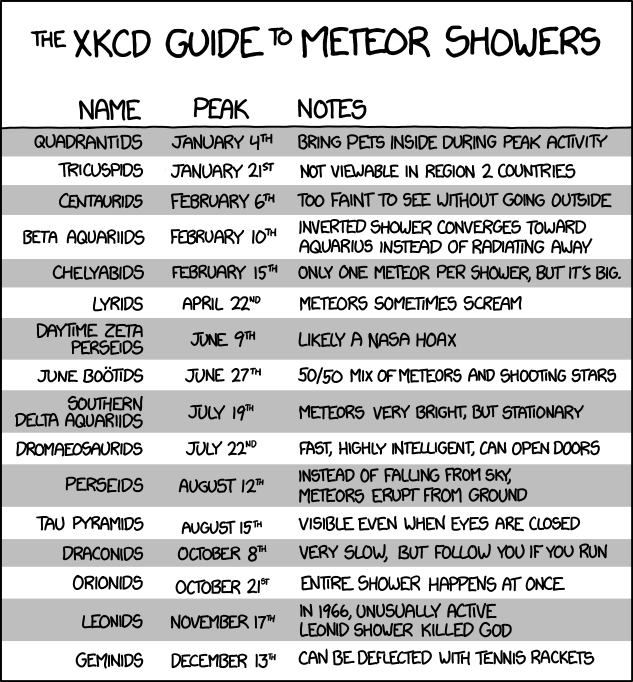
Every year, on or near my birthday: the fabulous Perseids!
But I’m not greedy — I’ll share them with you.
Here’s some explanation from NASA:
And a quick and easy guide, courtesy of xkcd:
Over at Chad Orzel’s Uncertain Principles blog, he mentions that a colleague of his is doing a research project with a summer student, about physics education.
You can help. Because they need data. There’s a survey, and the more people participate, the better.
More participants = better science!  You want better science, don’t you? Of course you do.
It’s short, it’s painless, and to entice you to take part, they’ll automatically enter you into a raffle for a new Google Nexus 7 32gb tablet.
Yes, they’ll need to take your email address (so they can inform you if you win), but they won’t use it for nefarious purposes. Because they are scientists. They will not spam you. Trust me.
Here’s the quote, with survey address, lifted from Chad’s blog:
I’m doing a summer research project at Union College with a student, and I need as many people as possible to fill out a survey that we created. If you complete the survey by 11:59pm (EST) on Sunday, August 11, 2013, you will be entered into a raffle to win a Google Nexus 7 Tablet (32Gb), and you will receive an additional entry into the raffle for each person that lists you as a referrer. You can find the survey at http://tinyurl.com/q7pmzlh. It should only take 5-15 minutes. Thanks!
The scientists themselves remain intriguingly anonymous.  I assume, so as not to unduly influence you with their mellifluous cognomens.
I was doing some file cleanup and backup and reorganization, and it brought to mind some scenes and bits that were edited out of the final versions of some of the Steerswoman books…
The things that were cut were all cut for various good reasons — mostly having to do with focus and pacing. But I was a bit sorry to see this particular bit go, since without it something unexplained had to remain unexplained.
So, it occurred to me that some of you might be interested in seeing it…
Just a lost fragment that never made the final cut. Incomplete — not even an entire scene. And ending rather abruptly, as (so I now believe) I realized that it would not fit smoothly into the thread of the tale, and so just stopped writing it.
But interesting (well, to me), and an explanation of sorts.
It takes place the night before Rowan, Steffie and Zenna sail away in Janus’ nameless boat:
——
The boat shifted on the wharf-side, rocked back into position. Someone had come aboard. “Rowan?”
The steerswoman clambered up to the deck. “Here.”
Zenna was outlined by lights from the harborside buildings. “You took your time,” Rowan noted.
“I lost track. I found something interesting in the Annex.”
“What?”
Zenna maneuvered awkwardly across the gently rocking deck. “Let’s go below. We need some light.”
“What is it?” Puzzled, Rowan led the way below, preceding Zenna and carrying the other woman’s crutches as she descended the companionway.
Seated at Janus’ little table, Zenna pulled an object from her satchel, handed it to Rowan. “Look at this.”
A steerswoman’s logbook, of a design standard forty years ago. Rowan turned to the first page. “Mira’s?” The leather was crusted with damp-mold. Rowan pried apart the warped pages.
Zenna leaned forward and indicated something tucked between two leaves. Rowan pulled it out: a folded and refolded sheet. “Is it a map?” She lifted one edge, took one look —
Then dropped the book, snatched the candle nearer, set the chart on the table and set to unfolding it — but carefully, carefully, so as not to break the aged paper…
Fine lines, delicate colors, more like a work of art than a map. Roads mere gray threads, almost invisible in the candle-light; towns a spread of tiny rectangles, possibly indicating the individual buildings themselves. Rivers, brooks, every upthrust of crag and hill: all in maddening detail, in washes of color impossibly steady and pure. She had seen such a map before. “This is a wizard’s map.”
“I figured as much.”
Rowan’s mind was a flurry of excitement, as she mentally tested superpositions of known Steerswomen’s maps. “This part might be the northern limb of the Mountains.” She found a town she knew. “Here’s Terminus.” Farms were identifiable by the regularity of their limits but there were fewer than she knew there to be. “This map was already old when Mira found it.” Fields showed distinctive colors, perhaps schematically representing type of crop; or perhaps, Rowan thought with an eerie thrill, perhaps depicting the actual color of each kind of vegetation, as seen by an eye hung high above the world.
Zenna indicated the western section of the chart.
“Yes,” Rowan said, feeling a grin on her own face. Beyond the known mountains: yet more mountains, continuing, peak behind peak, and none of them to be found on any Steerswomen’s map, none of them seen by or known to any steerswoman. “This is wonderful! Look, look at this gray area; I think that’s a narrow valley, and if the color is right it must be blackgrass that’s growing there, like they have in the Outskirts. And look, this lake here, with the brook –” Rowan laughed out loud. “Skies above, Zenna, we’re looking at the source of the River Wulf!”
Zenna watched her, head tilted slightly back. She had recovered the logbook; now she held it toward Rowan, open to one page, where one sentence stood alone:
They know everything.
Rowan glanced at the words, shook her head at the distraction, and immediately returned to the treasure of the wizard’s chart. “Zenna, here, look at these faint numbers; they’re everywhere. When I saw them on Shammer and Dhree’s map, I thought at first that they might be elevations, but they don’t match ours at all…I wonder what they might be?â€
Zenna placed the logbook before her again, on top of the chart. She indicated the lone sentence.
“What?” Rowan asked her.
As if the action constituted reply, Zenna riffled the rest of the pages, to the back of the book; all were blank.
Rowan looked down at it, then up into her friend’s face. Zenna was expecting some specific reaction. Rowan shook her head, spread her hands.
Zenna prompted her. “Who do you think ‘they’ are?”
“The wizards, I assume.”
“So do I,” Zenna said. “It explains a lot, don’t you think?”
Rowan was completely at sea. “What does it explain?”
“Mira. We were wondering how any steerswoman could ever possibly come to live and behave as Mira did. How she could ever abandon her work, and all regard for the work of the Steerswomen.”
Rowan looked at the map, at the words in the book. “I don’t understand.”
“But don’t you see? Mira somehow acquired this map — it’s very old, she might have come by it any number of ways — and she saw how much more the wizards know than we do.”
“But that goes without saying. Of course they know more than we do, about any number of things.”
“Everything we try to find out, they already know.”
“Possibly.” Rowan sat regarding the other woman, and worked through a number of intellectual recombinations of the information at hand, trying to fathom Zenna’s behavior. She failed. She threw out her arms helplessly. “And?”
Zenna’s frustration was melting into something like amazement. “You really don’t see, do you?”
“Not at all.”
Zenna looked at her for a long, disbelieving moment; then astonishingly, she laughed out loud. “Oh, Rowan!” She pushed herself erect and threw herself half-falling into Rowan’s arms, embracing her, laughing. “Oh, Rowan, bless you, please, never change! Stay like this for the rest of your life!”
Rowan held her, uncomfortably wedged amid arms, table, and chair-back. “You mean,” she said over Zenna’s head, “confused?”
“No, of course not.” Zenna clumsily extracted herself and regained her seat. “Rowan,” she began; and her expression was so filled with affection and admiration that Rowan felt disturbed and deeply uncomfortable at its inexplicability, “what’s more important: truth, or the act of discovering it?”
Rowan opened her mouth to reply, then hesitated. “You can’t separate the two. For a truth to exist, someone has to discover it.”
“And you’d like that someone to be you.”
“It’s what I love to do.”
“Suppose that you discovered something, something you thought was known only to you, then found that someone else had been there already, had already known everything you struggled to learn?”
Rowan shifted uncomfortably, made vague gestures. “I suppose I’d try to gain access to that person’s work. Perhaps the person knows even more, and could save me a lot of time and effort.”
“But it wouldn’t bother you?”
“Why should it?”
Zenna folded her hands and spoke slowly and patiently. “Suppose you were different than you are. Suppose that what you loved most was not just truth, nor the act of discovery,” and she stressed the next words, “but the fact of being the discoverer.”
Rowan felt she needed all of her concentration to follow this, and she closed her eyes, straining in thought. “I don’t see any distinction. A discoverer discovers. That’s what it means.”
“The fact of being the first one, of being that person who has struggled and striven, and has come back with knowledge that would not exist, but for you.”
“But the truth doesn’t care who discovers it.”
“People do care.”
Rowan was disappointed. “Are you saying that… that what Mira cared for was securing other people’s regard?” Such a petty thing…
“No. Not just other people’s. When one says ‘people’, one has to include oneself. We regard ourselves, Rowan. We think of ourselves, and we care about what we are.” Zenna pulled the logbook across the table, turned it so it faced her, flipped through the earlier pages. “I think Mira loved her life because it permitted her to be what she wanted to be. In her own eyes, not the eyes of others, it gave her stature, it gave meaning to her life. She wanted to be the one who finds things out. The first. New things, that no one had known before.
“She had been working in the western mountains, you know; that was her area. But when she found this map, she realized that the thing she loved about herself was untrue, a sham. It had all been done before, by others, and much better than she ever could have done.”
Rowan looked down at her scarred hands — human hands lying on the impossible, magical colors of the map. “But it doesn’t matter…”
“Not to you. It mattered to her. Try to see it her way. Think of the thing that you love best about yourself, and imagine it taken away.”
Rowan tried, failed. “I don’t know what I love best about myself…” She sought for it in her mind, but there seemed to be nothing to seek. “I… I don’t think I can break myself into pieces like that.” And viewed that way, it did seem there was something, not a separate thing, but more like an aspect; but she could not hold on to it. It was like trying to touch the green-ness of a leaf without touching the leaf. “Whatever it is,” Rowan said, “I don’t think it can be taken from me.”
“Perhaps you’re right about that.” Zenna’s face again showed that glowing admiration, and Rowan shied away from it almost physically, thinking: I‘ve done nothing to deserve that.
“Then,” Zenna continued, “imagine anything you love. Imagine it gone.”
Rowan found she had many specific examples. “I’d do what I can to get it back,” she said immediately.
“And if that were impossible?”
Rowan had not thought of Fletcher for months; she thought of him again now. “It depends on why it was lost. If it was taken from me, I think I’d try to exact some sort of justice.”
“And if that were impossible, too?”
Rowan threw up her hands. “I’d adjust to the situation and set my mind on something else. Are you saying simply that Mira was unwilling to accept a fact outside of her control? And is this intended to enable me to sympathize with her? Because it’s doing exactly the opposite; I hope you can see that.”
“Hm. I can see I’m getting nowhere. Has it ever occurred to you that not everyone is as strong as you are?”
“You’re using the term ‘strong’ in a very vague way. But, come to think of it, that doesn’t matter. Because, yes, I’m aware that some people are not as strong as I am, just as I’m aware that there are plenty of people far stronger than I, by whatever definition of the word you choose.”
——–
That’s it; that’s all.  Left on the cutting-room floor, so to speak.
I’ve been wrapped up in tons of writerly tasks that, while not actually generating prose, support and enable the future generation of prose. Ate up my entire weekend plus day off. But necessary.
About which, more Real Soon Now. But I finally found a few moments in which to blog!
People have asked for more on the collaged book-boxes Ann and Geary and I made at this year’s post-Readercon gathering. Alas: nearly all the photos came out horribly blurry! I think I was wearing my wrong glasses at the time.
(Annoyingly, I now have three sets: 225’s that I use to read print, 150’s that I use to read computer screens, and a graduated focus pair that are mostly plano with a 225 reading area — which I hate, because the area is about the size of one word on a printed page, requiring me to read by moving my head as if I were watching a ping-pong match.)
I’ve pulled out the least blurry of the photos.  (Hey, Ann & Geary: if you want, take some new pictures of your own books, and email them — I’ll replace these with your better ones.)
We each made two book-boxes this time: one large and one small.
This was mine:
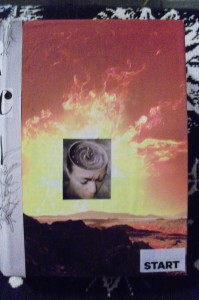
cover of my big book
The Spine
The back.
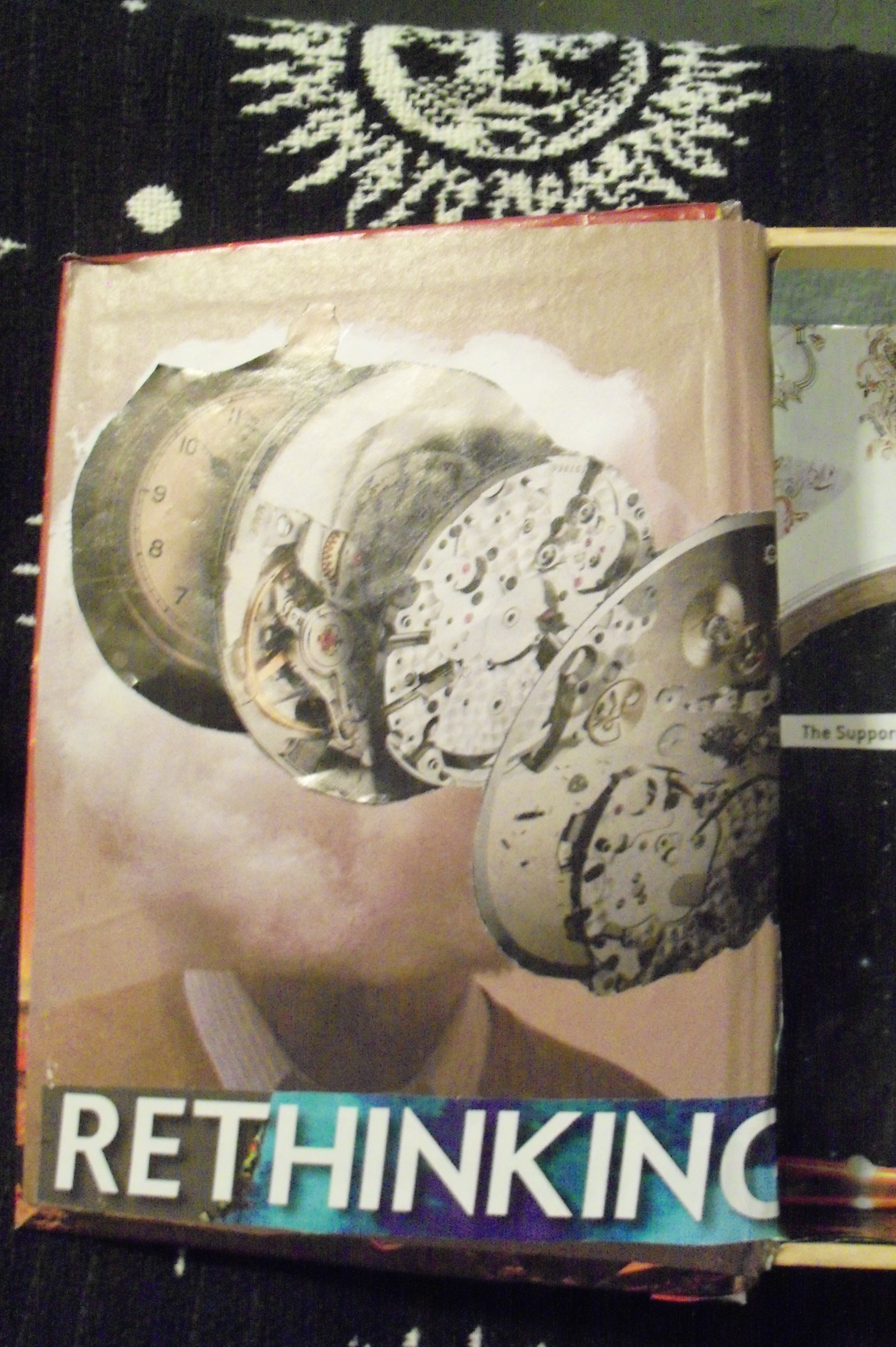
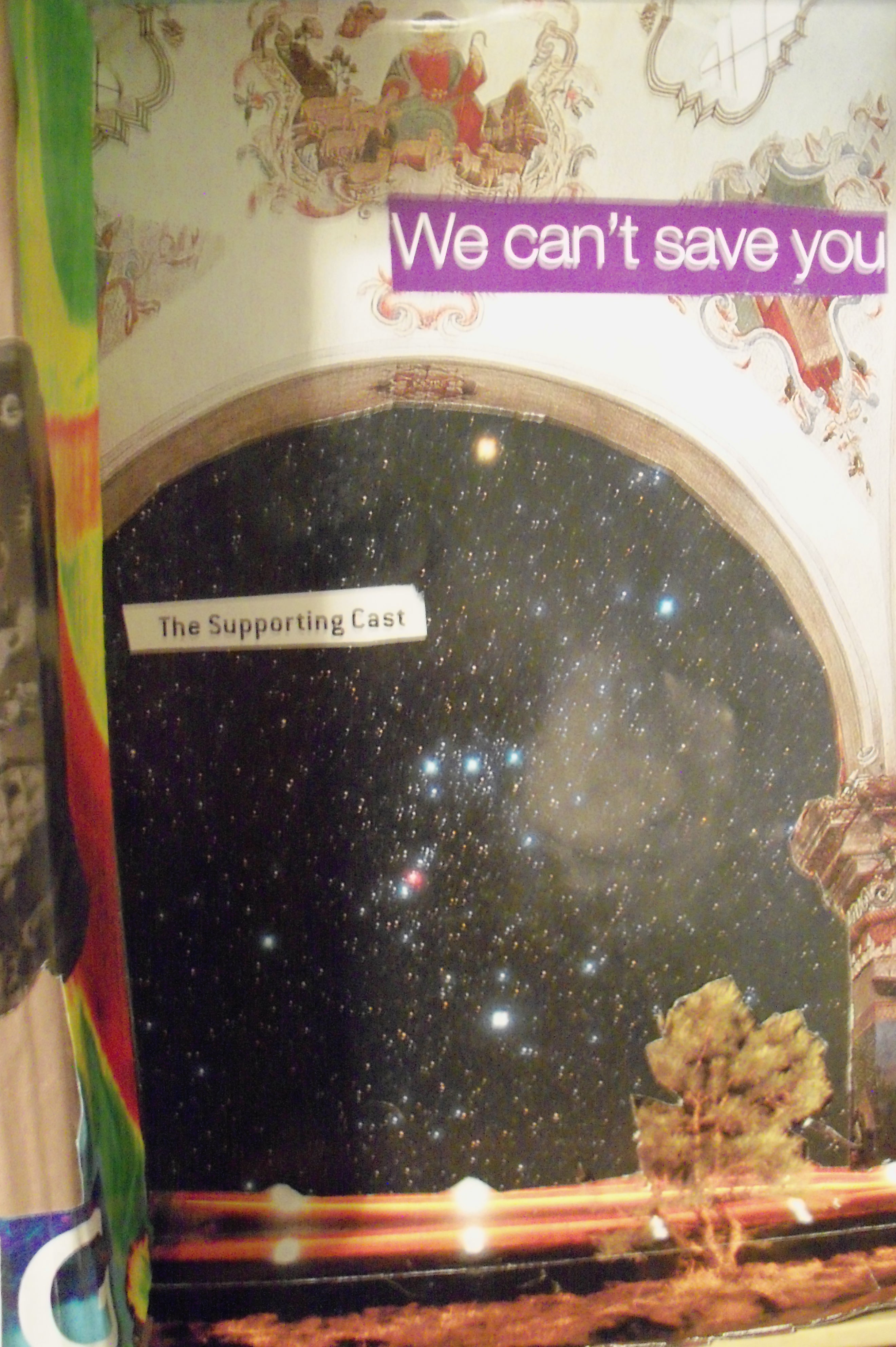
And the smaller book:
The cover
Spine
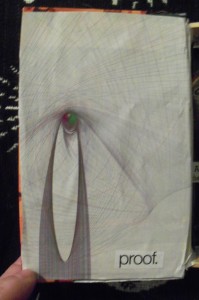
inside cover
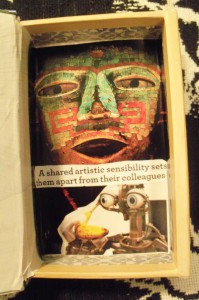
Inside
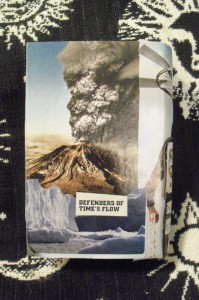
Back cover
Geary’s:
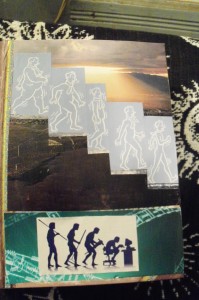
Front of the big book
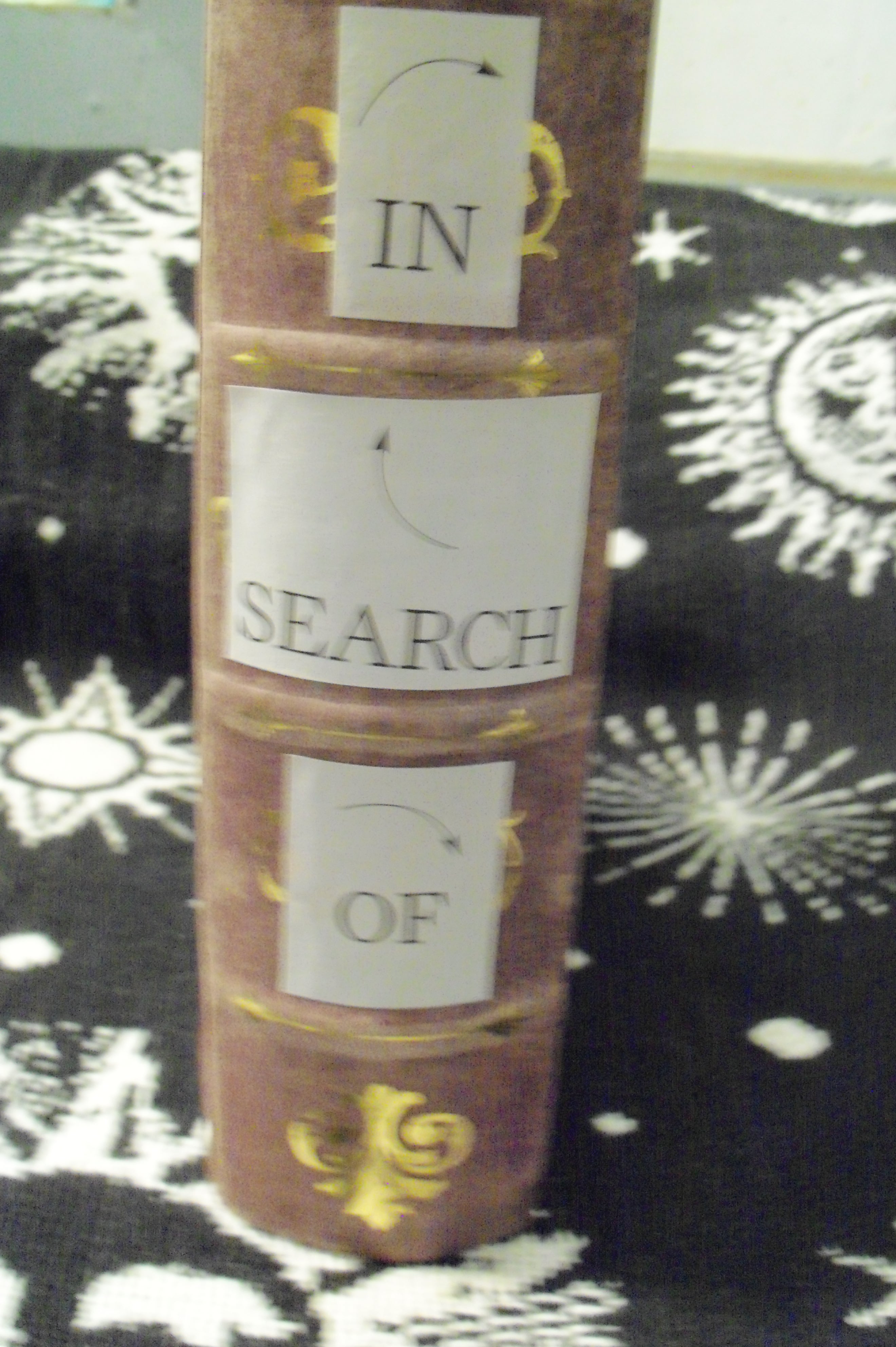
Back
inside cover
inside
Here’s his second:
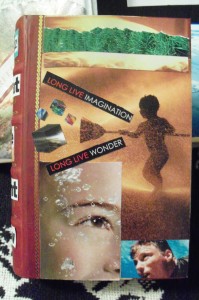
cover
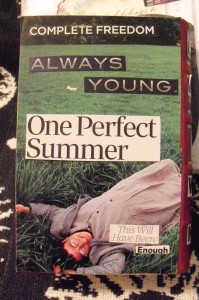
back
inside cover
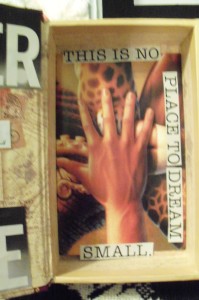
inside
And Ann’s:
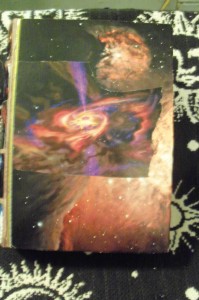
Cover of Ann’s big book.
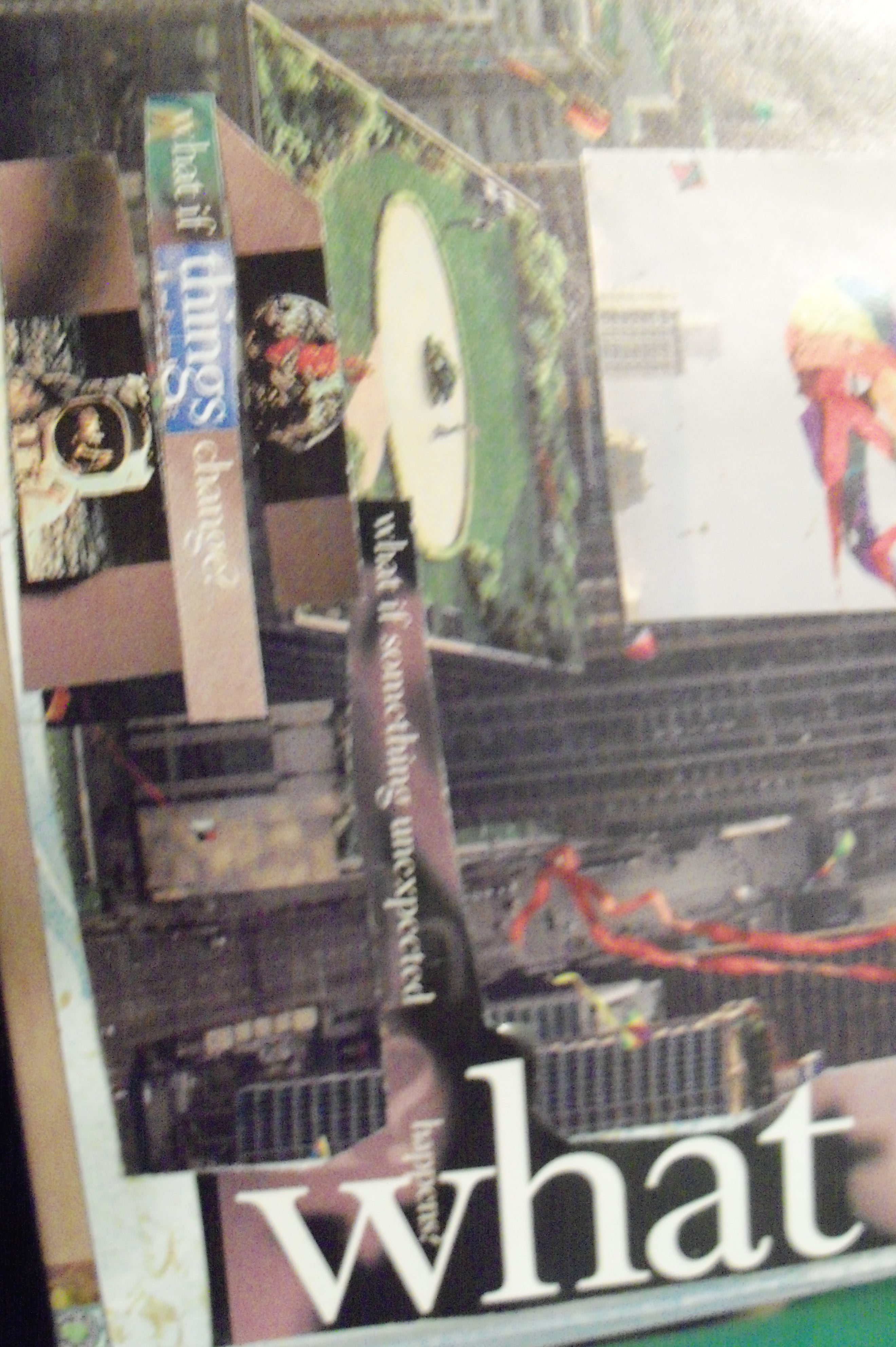
and the back.
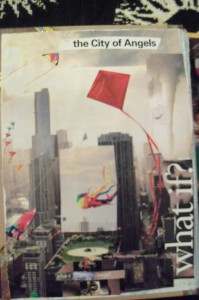
inside
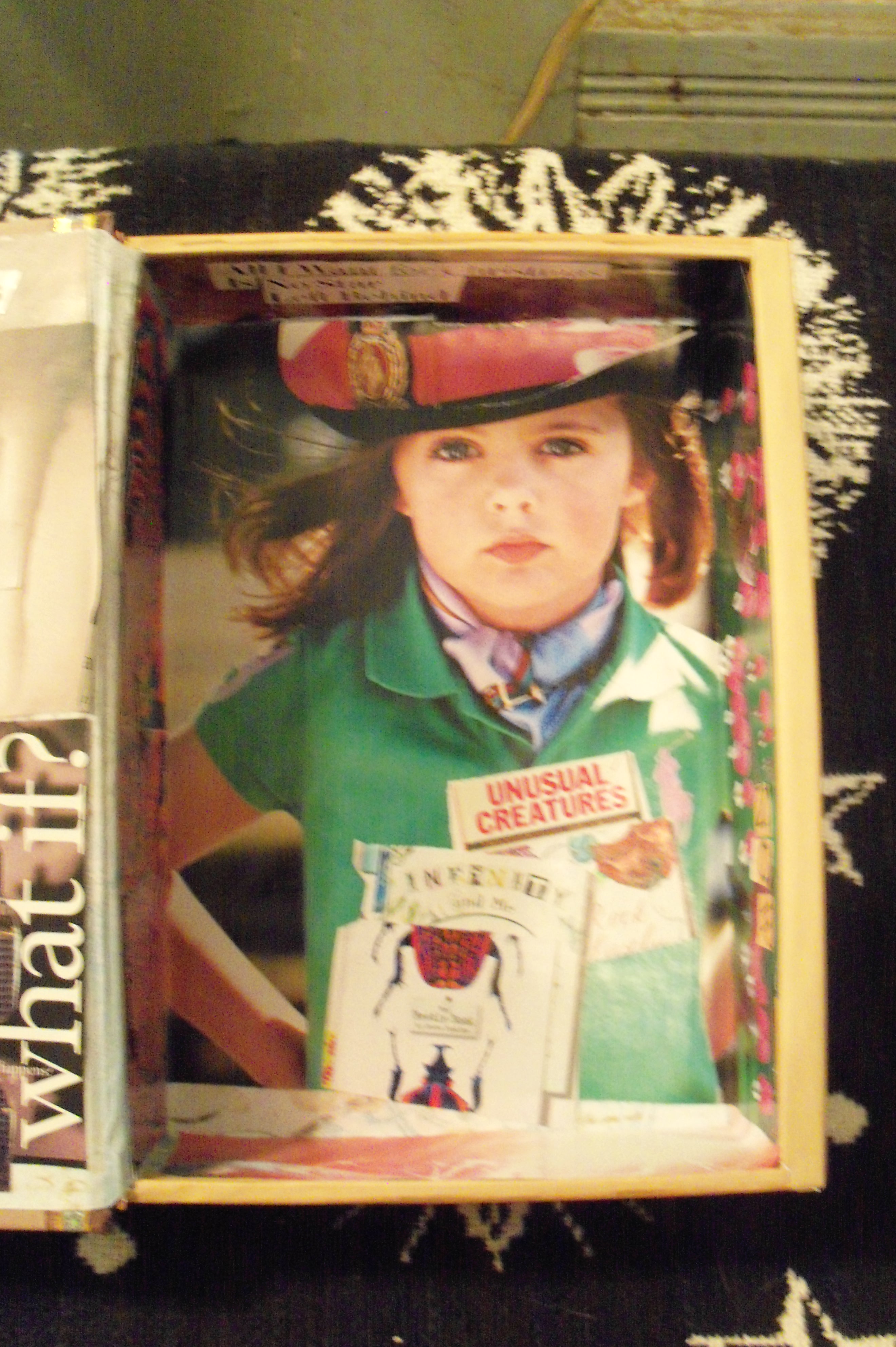
Her smaller book:
cover
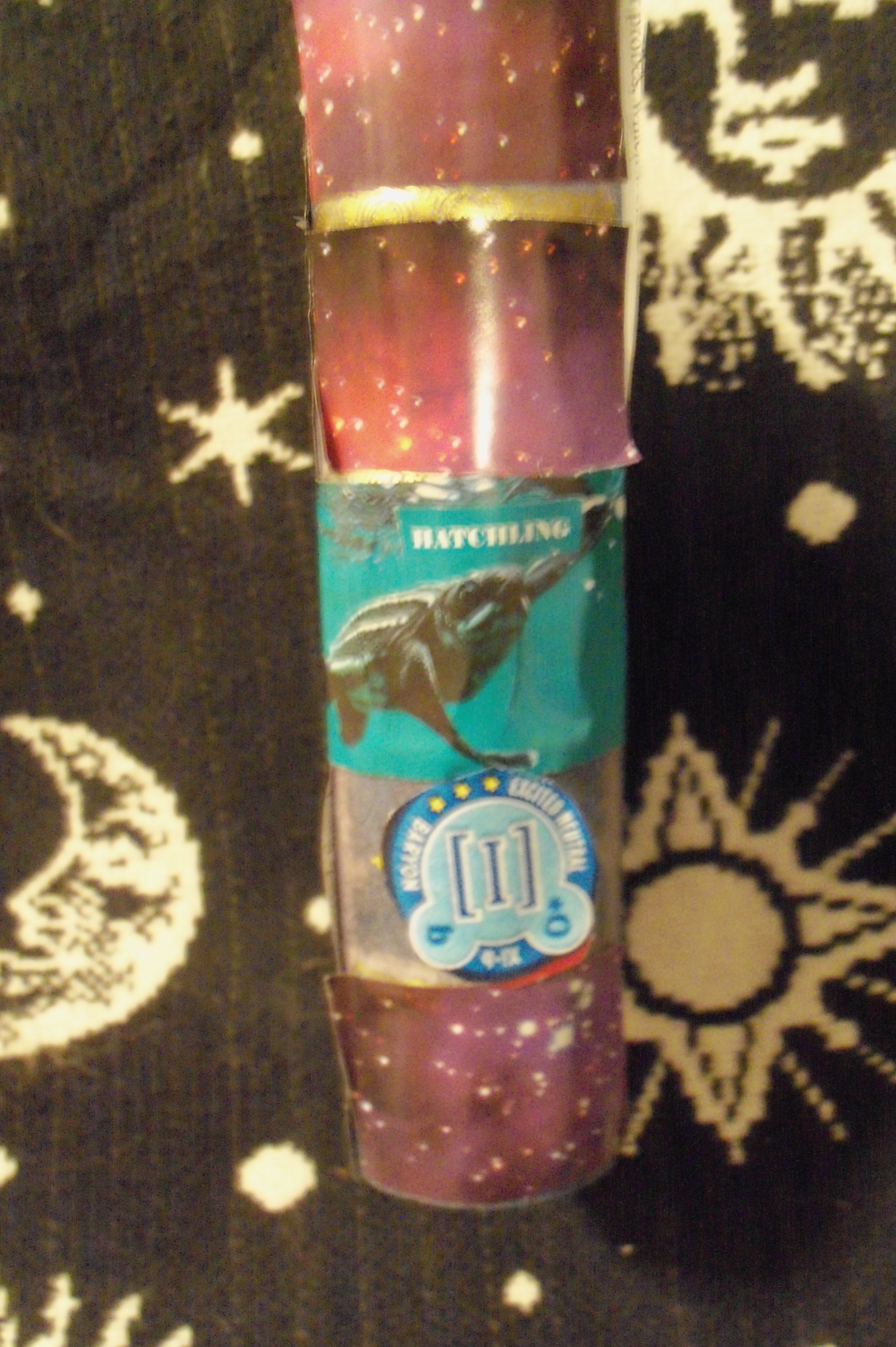
inside cover
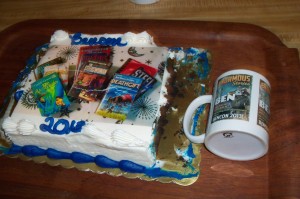
And finally: The cake (courtesy of Geary), and party favors (from me).
(PS: Always read the hovertext. )
Hot. Hot hot hot.  Northeast was miserable all week and all weekend!
Readercon was lovely, however, despite — or possibly because of — having to drive there and back on Thursday for my two events, and drive back for the weekend after work on Friday.
Someone suggested to me that Thursday at Readercon is attended by only the most dedicated and devoted of fans.  Possibly that’s true, given that most people would have to take actual time off work to be there by Thursday.    A purer, more distilled Readercon, perhaps?  Actually, Readercon is really already distilled, focusing as it does on actual readable works and eschewing other media. La creme de la creme de la creme, perhaps?
Well, I certainly had a grand time.
The panel “The Bit I Remember” came off well, I thought, with Howard Waldrop, Sonya Taaffe, Yoon Ha Lee, Ellen Brody and I contributing reminiscences of tales and parts of tales that stuck with us long after the stories in question were read; and discussions of why, and how.
I had my sad tale of Heinlein’s Podkayne of Mars, the book that got me hooked on science fiction.  Loved it, as a kid — later discovered that its message was exactly the opposite of what I thought it was. Alas.
But then I also got to share my experience with John Wyndham’s Rebirth (The Chrysalids, in Britain) — where every time I read it I found more and more to love: Starting with “Ooh, telepathic kids, neat!” at around age 12; through “Wow, nuclear apocalypse that’s so deep– !” at about 14; through “The evils of forced conformity — true, so true!” at about 16; through “Religion as a tool of suppression – amen to that!” at about 19; to, sometime after I had become a published author in my own right, “Holy Moses — look at the prose, look at how the thread of the tale is spun out, look at what’s said and what’s not said, look at how he makes the reader discover the tale …this guy really knows how to write!
And an interesting moment came when Yoon Ha Lee brought up reading Poul Andersons’ Brain Wave at age twelve — which I read at pretty much the same age, give or take.
She hated it! I loved it!
Things that made it unreadable to her just washed over me with no effect. At one point, I was mentioning how my identification as a reader was more with the male characters, and the lesser role of the females didn’t outrage me at that age — and she gave me a puzzled side-glance that I could not help but read as a polite version of: What, are you crazy?
It wasn’t until later, when Waldrop mentioned the old witticism that the “Golden Age of Science Fiction” is 12, that I realized something:
Yoon Ha Lee read Brain Wave at age twelve. I read it at age twelve.
Yoon Ha Lee’s age twelve was in 1993.  My age twelve was in 1965.
And that was the difference.
In 1965 there were almost zero female protagonists to be found in science fiction. Of course I was identifying with the males. Of course it was their story that was the story. I was too young to know it was possible for things to be different.
All the things I liked about Brain Wave still exist, of course.  But Yoon is certainly right that women were given rather short shrift; and their experience of the events of the book are based on that time’s expectations of women’s roles — which would absolutely be objectionable in 1993!
By the way, the book was written in 1953.  In retrospect, I’m amazed that women were present at all!
(For the record, there were two major female characters. One was a secretary, the other a housewife. When planet Earth moved out of the dampening field that had been suppressing electromagnetic processes, which life on Earth had evolved to compensate for, and the result was much more efficient brain function, allowing for greater possible operational intelligence — the secretary could handle it and the housewife, tragically, could not.)
Alas, I realized the huge gap between my twelve and Yoon’s much too late to add it to the discussion onstage.  The conversation had moved on.
One of the more interesting panels I’ve participated in.  You know, you can’t always tell by the printed description in the program schedule.
And my reading was one of the best-attended I’ve ever had.  There must have been about a dozen people there — I was quite surprised.
I hadn’t decided beforehand what I would be reading, choosing to leave the choice to the last minute (hoping, frankly, for some inspiration).  When I arrived I explained that much of my new stuff was in flux; and of the parts that were readable, I had already read all I could without going into spoilers, at previous readings.  So I would be reading from something already published….
And then, hooray! Inspiration did strike me!
In the form of: me addressing the audience, and asking “Is there anything you would like to hear me read?”
A hand shot straight up, immediately, no hesitation. I called on the woman. She said (or words to the same effect): “The part where Rowan and Bel are at the campfire, and their discussing the giant throwing the jewels, and drawing diagrams on the ground.”
Perfect! Moody, scientific! A neat encapsulation of the tone and sense of the whole series, in one scene! And the scene that immediately follows that is a great action sequence.
And that’s what I read. I think it went well.  I certainly had fun.
Immediately after the reading, some people came up for autographs, including the hand-raiser, who said: “Thank you for the teapot!”
Yes, it was Mary Alexandra Agner, winner of the latest Teapot contest — and a writer herself, of stories, articles and poetry.  I was so glad to meet her.  (And you should explore her website.)
Hm. I see I’ve spent rather a long time on this post already… I’ll have to make the rest brief:
Readercon was much smaller this year than previously, I believe — which is not a bad thing, as long as they were able to break even on their costs.
My actual autographing was at the end of the convention, and I think only one person asked that something be signed.
The “Constellations of Genres” panel was, alas, a snore.
John Crowley’s presentation on “Teaching Utopia” was fascinating.
The backlist/ebook panel (including Betsy Mitchell, who did such a brilliant job editing The Lost Steersman back when she was with Del Rey Books) was very interesting…
And the Crowdfunding panel was excellent, with lots of examples, suggestions, warnings, encouragement, etc.
After the convention, as is now usual, I spent some quality time with Ann Tonsor Zeddies and Geary Gravel. And there are pictures of our crafts project, but alas, I have to stop writing this now.  So I’ll write about that later this week.
But here’s a teaser:
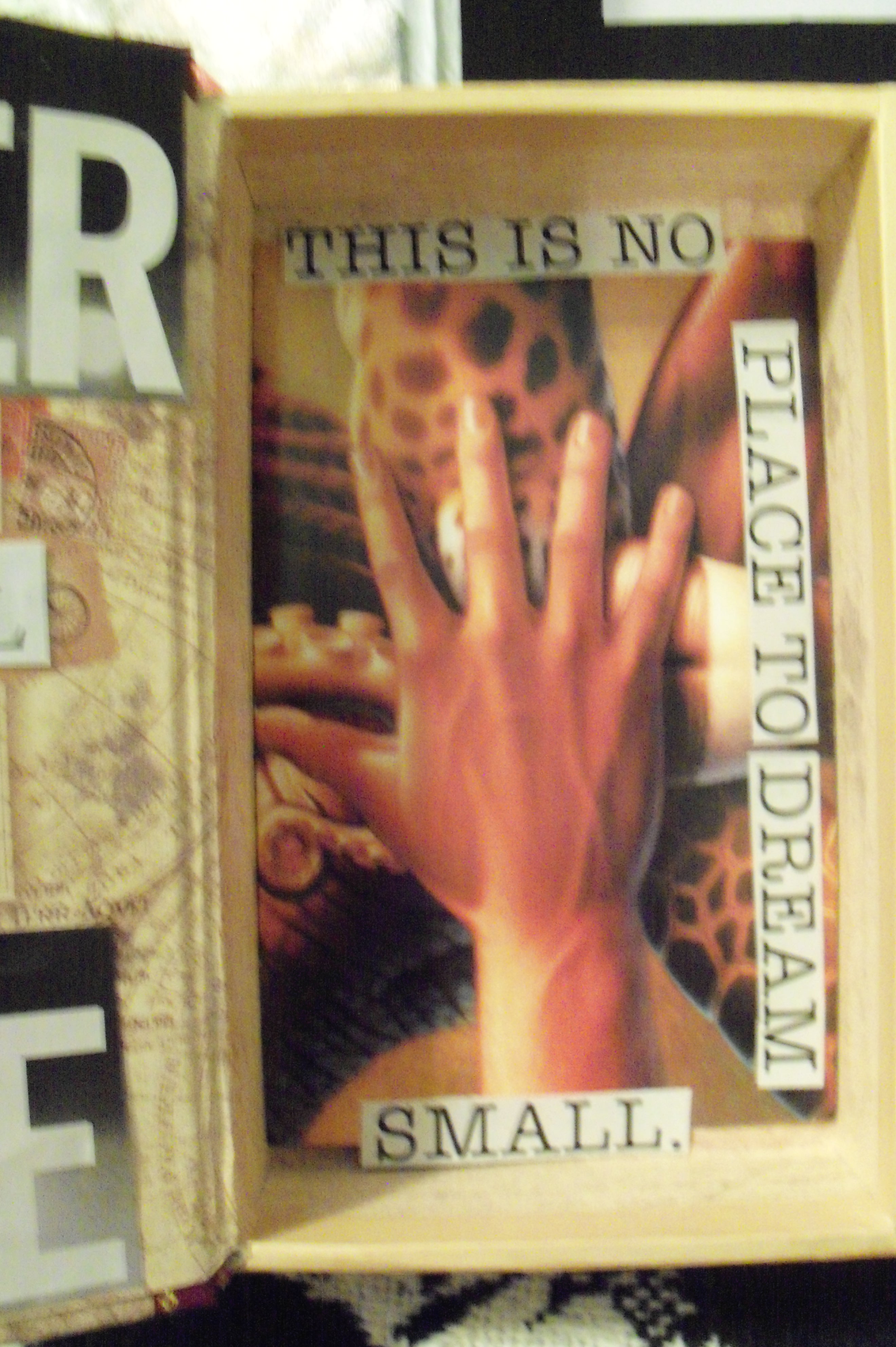
One of two that Geary made…
I’m back from Readercon and the usual post-con gathering — but I’m wiped out from the heat-wave and driving hours and hours with no A/C in the car. Yikes.
I’m so tired I can barely think. Plus: now I have to clean up the shambles I left the house in when I rushed out the door on Friday.
I am too brain-dead to post an actual post….
So, you should check out my sister Sabine’s brand new blog: Interstates and Interwebs! This isn’t her first blog, but this one is focused on following her on her amazing adventures as she drives completely across the country and back, while doing odd jobs she picks up on various apps and websites.
She left last Thursday.  She’s already in South Dakota. The B&B has dogs.
Bye. Must go buy food now.
Yes! I will be at Readercon!
However: due to reading my writer-related email quickly and surreptitiously at the DayJob, I okayed the following schedule:
Thursday July 11
8:00 PM F The Bit I Remember. Ellen Brody, Lev Grossman, Rosemary Kirstein, Yoon Ha Lee, Sonya Taaffe (leader), Howard Waldrop. What do we remember from books read long ago, and why? What makes these glowing moments stick in our heads? And conversely, what falls away only to startle us when we return to the narrative years later?
9:00 PM NH Reading: Rosemary Kirstein. Rosemary Kirstein reads a work to be determined.
Friday, July 12
10:30 PM Meet the Pros Party
 Sunday July 14
12:00 PMÂ Â E Autographs. Mike Allen, Rosemary Kirstein.
Yep, that’s it.
Plus: I thought I’d said I wouldn’t be there until Friday night… but that might have been an error on my part. However, when they sent the preliminary schedule for me to approve, I ought to have caught the date, and asked for a change!  I do believe that I somehow (in a rush, probably) saw that F next to the time, and thought, “Friday! Yeah, I’ll be there. Let’s give a big OKAY for that.” But, alas, it was the room number.
So: I will be driving to the convention on Thursday night for the two events, then driving back so I can get to the DayJob on Friday morning, then going back to the con for the full weekend.
Upside: I’ll have plenty of opportunity to watch panels instead of being on them.
What am I reading at my reading? At this point, I still don’t know.   I’ve read all the non-spoilery bits from the next two books (in progress simultaneously, dammit).  I can read something from them that I’ve already read, since the people in the audience might not be the same ones who heard a particular bit; or I can read from published work, where the attraction is not that you’d hear new stuff, but that you’d hear me reading it; or, I can read from some non-steerswoman work-in-progress — which I will probably be very unlikely to do, as I’m on the fence exposing it to public scrutiny at this stage…
I will probably decide at the VERY LAST MINUTE.
Also: I seem to have no kaffeeklatsch this year!  If anyone is interested I’ll put together an informal get-together, which will resemble a kaffeeklatch, taking place somewhere like the lobby, or the poolside, or one of the outside sit-around places, if it’s not too hot. Let me know if I should do this…
In other news: They fired my boss at the DayJob.  Suddenly. My co-worker and I were unexpectedly and suspiciously taken out to lunch by the production assistants, who were all perky cheery and innocent. But it was all a ploy to get us out of the office while our boss had his office cleared out, and was told, politely I hope, to hit the road.  His duties are now divided among three people, and, as they say, it’s all of a ’tis-was now.
On the upside: I still have Mondays off!  So, my cunning plans can proceed.
More to tell, about stuff in general — but I have to STOP BLOGGING SO I CAN GO AND WRITE NOW.
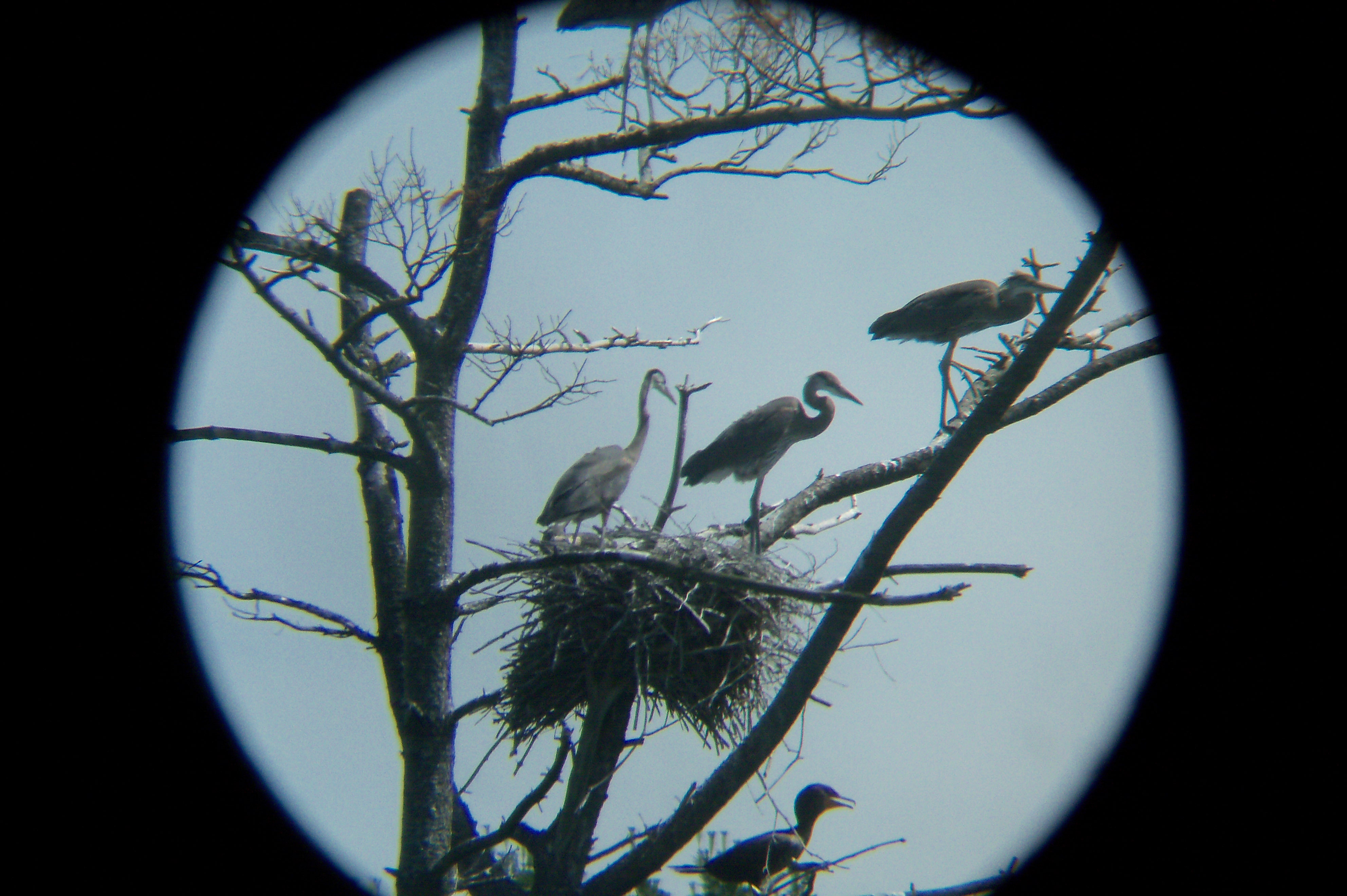
The condos next door seem crowded, and not up to code, but at least the neighbors are entertaining.